Accidental Death vs Life Insurance: What You Need to Know


Life insurance pays a death benefit for almost any cause of death; AD&D (accidental death and dismemberment) pays only when a covered accident causes death or a specified injury. For most people, life insurance should be the foundation of their coverage, and AD&D is a low-cost supplement worth adding when an employer offers it cheaply or when you specifically need dismemberment benefits. Roughly 90% of U.S. deaths stem from illness, disease, or natural causes, which means an AD&D-only strategy leaves the vast majority of mortality risk uncovered.
Table of Contents
1. How life insurance actually works
Life insurance pays a death benefit to your named beneficiaries when you die, regardless of whether the cause is a heart attack, cancer, stroke, or a car accident. That broad trigger is what makes it the right foundation for income replacement.
Policy types break into two camps. Term life covers a set period, typically 10, 20, or 30 years, and pays only if you die during that term. Permanent policies, including whole life, universal life, and indexed universal life (IUL), stay in force for your lifetime and build cash value over time. For pure income-replacement protection, term life usually delivers the most coverage per dollar.
Underwriting is where life insurance differs most sharply from AD&D. Insurers evaluate your age, health history, tobacco use, and lifestyle before setting your premium. A 35-year-old nonsmoker in good health will pay far less than someone the same age with diabetes or a history of heart disease. That process takes time, but it also means the policy is priced to cover you specifically.
One important mechanic: the contestability period, which typically runs two years from the policy issue date. During that window, an insurer can investigate a claim for misrepresentation on the application. After two years, a valid death claim is generally paid on presentation of a death certificate with no investigation required.
Pro Tip: Adding an AD&D rider to an existing life policy is usually cheaper than buying a standalone AD&D policy. If your beneficiaries would receive both the life benefit and the AD&D benefit on a covered accidental death, that “double indemnity” effect can be meaningful at a modest additional cost.
2. How AD&D coverage works and what it actually pays
AD&D pays when death or a listed injury results directly from a covered accident, with no contributing illness or disease. Many policies also require that death occur within 90–180 days of the accident itself. If you survive the accident but die later from a related infection or organ failure, the insurer may dispute whether the cause qualifies.

The dismemberment schedule is what separates AD&D from every other life product. Instead of a single lump-sum death benefit, AD&D assigns a percentage of the policy face value to each type of loss. A typical schedule looks like this:
Loss | Benefit paid (% of policy amount) |
Loss of one limb | 50% |
Loss of sight in one eye | 50% |
Loss of one hand or foot | 50% |
Partial payouts matter for workers in physically demanding jobs where a single-limb or single-eye loss is a realistic risk. Life insurance would pay nothing in those scenarios because the policyholder is still alive.
AD&D is widely available as a guaranteed-issue group benefit through employers, which means no medical exam and no health questions. That accessibility is a genuine advantage for people who cannot qualify for standard life insurance underwriting. Standalone individual AD&D policies do exist, but they are less common and typically require more scrutiny.
Common AD&D exclusions: illness or disease, suicide, intoxication or driving under the influence, non-prescribed drug use, criminal acts or felony participation, private aviation, war or combat, and many high-risk recreational activities. If any of these factors contributed to a death, the insurer can deny the claim even when an accident was also involved.
3. Accidental death vs life insurance: a side-by-side comparison
The table below maps the core decision axes so you can see at a glance where the two products diverge.
Dimension | Life insurance | AD&D insurance |
Payout trigger | Death from almost any cause (limited exclusions) | Death or listed injury caused directly by a covered accident |
Types of payout | Lump-sum death benefit | Death benefit + partial dismemberment schedule |
Relative cost | Higher premium; reflects broad coverage | Lower premium; reflects narrow, low-probability triggers |
Term / expiration | Term (fixed period) or permanent (lifetime); face value stays constant | Often tied to employment or a rider term; group benefits may reduce at age 70–75 |
Availability | Underwritten; health and lifestyle affect eligibility | Often guaranteed-issue in group plans; individual policies may be underwritten |
How coverage is added | Standalone policy; riders available | Standalone policy, employer group plan, or rider on a life policy |
Best for | Primary income replacement for dependents | Supplemental accidental coverage; dismemberment protection |
Foundation vs supplement | Foundation | Supplement |
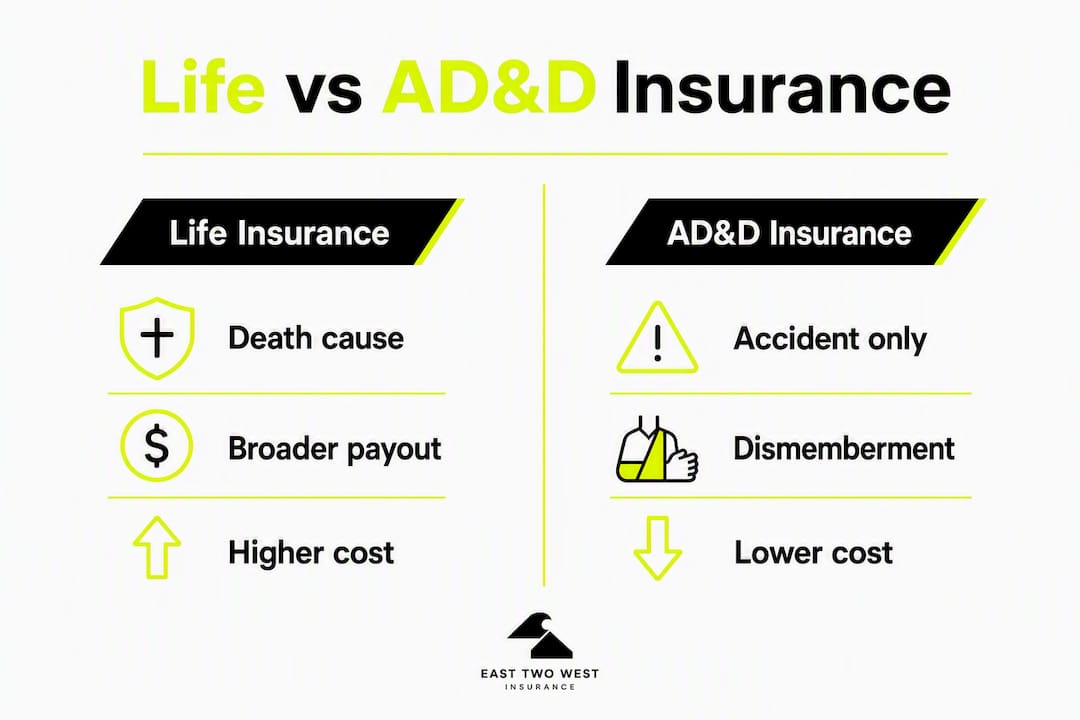
A few rows deserve extra attention. On cost, AD&D premiums are lower because insurers expect to pay far fewer claims, not because the product delivers better value per dollar of protection. On term mechanics, many group AD&D plans reduce the benefit at set ages, sometimes to 65% or 50% of the original face value at age 70 or 75. Life insurance face values generally hold constant for the policy term or lifetime, which matters if you are planning coverage into retirement.
4. Who should seriously consider AD&D coverage?
AD&D makes the most sense as a supplement, not a standalone solution. A few situations where it genuinely earns its place:
High-risk occupations. Construction workers, truck drivers, commercial fishermen, and others in physically hazardous roles face a statistically higher chance of accidental death or dismemberment. AD&D adds a layer of coverage that reflects that specific risk.
Frequent travelers. Some AD&D policies include travel-accident riders that pay additional benefits for accidents during commercial air travel or while away from home.
Employer-sponsored group plans. When an employer offers AD&D at little or no cost as part of a benefits package, there is almost no reason to decline. Free coverage is free coverage.
People who already carry solid life insurance. If you have a term life policy sized to replace your income, adding a low-cost AD&D rider or accepting employer AD&D gives you a dismemberment benefit and a potential double payout on accidental death, at minimal extra cost.
People declined for life insurance. If a health condition prevents you from qualifying for standard underwriting, a guaranteed-issue AD&D plan provides at least some accidental protection while you explore other options like guaranteed-issue whole life or final expense coverage.
Pro Tip: AD&D should not be your only coverage if you have dependents. Because the overwhelming majority of U.S. deaths are from illness and natural causes, a policy that only pays on accidents leaves your family exposed to the most likely scenarios.
What AD&D does not do well: replace income when a breadwinner dies of cancer, heart disease, or a stroke. Those are precisely the deaths most families need to plan for, and AD&D pays nothing for them.
5. Do you need both? A practical decision guide
Buying both life insurance and AD&D is not automatically the right move. The case for carrying both comes down to three factors: cost, existing coverage, and specific risk profile.
Pros of adding AD&D to a life policy:
Dismemberment benefits that life insurance does not provide
A potential double payout if an accident causes death (when an AD&D rider stacks with the life benefit)
Low incremental cost, especially through an employer group plan
Guaranteed-issue access for people with health conditions
Cons and trade-offs:
Group AD&D typically ends when you leave the job, leaving a coverage gap at retirement
Benefit reductions at older ages mean the coverage you counted on may shrink when you need it most
Tight exclusions and causation requirements mean claims are denied more often than policyholders expect
Money spent on standalone AD&D might be better used to increase a life insurance face value
A short decision checklist:
Do you have dependents who rely on your income? If yes, buy life insurance first, full stop.
Does your employer offer AD&D at low or no cost? If yes, take it.
Do you work in a high-risk occupation or want dismemberment coverage? Consider an AD&D rider on your life policy.
Are you declined for life insurance due to health? Explore guaranteed-issue life options first; AD&D can fill a gap in the meantime.
Is your life insurance face value already adequate? Then a low-cost AD&D rider or employer plan is a reasonable add-on.
The sequencing matters. Secure a base life policy sized to your income-replacement needs first. Then evaluate whether employer AD&D or an AD&D rider makes sense as an affordable supplement.
6. How to get coverage: a step-by-step path
Whether you are buying life insurance, adding an AD&D rider, or both, the process is more straightforward than most people expect.
Check your employer benefits first. Many employers offer group life and group AD&D during open enrollment. Review what is provided, what it costs, and whether the benefit reduces with age.
Get underwritten term life quotes. Use an independent quote tool to compare rates from multiple carriers. Your age, health, and coverage amount drive the premium, so getting several quotes in one place saves time.
Decide on a rider vs. standalone AD&D. If you are buying a life policy, ask whether an AD&D rider can be added. Riders typically cost less than a separate policy and keep everything under one contract.
Explore guaranteed-issue options if health is a barrier. Final expense, guaranteed-issue whole life, and some group AD&D plans skip the medical exam entirely.
Apply and complete underwriting. For standard life insurance, expect a health questionnaire and possibly a paramedical exam. AD&D group plans often require only enrollment paperwork.
Questions worth asking before you sign:
What exactly qualifies as a “covered accident” under this policy?
Is there a time limit between the accident and death for the benefit to apply?
Which exclusions apply, and does the policy exclude high-risk activities you actually do?
Does the AD&D benefit reduce at a certain age?
If I add an AD&D rider to my life policy, do the benefits stack on an accidental death?
Understanding ERISA plan protections also matters if your AD&D coverage comes through an employer-sponsored group plan, since state insurance laws may not apply the same way they do to individual policies.
7. Exclusions and claim scenarios that catch people off guard

AD&D claims are denied more often than policyholders expect, and the reason is almost always the exclusions or the causation clause.
Common AD&D exclusions:
Death from illness, disease, or infection (even if an accident preceded it)
Suicide or self-inflicted injury
Intoxication or driving under the influence of alcohol or drugs
Non-prescribed drug use
Participation in a criminal act or felony
Private aviation (many policies exclude non-commercial flights)
War, combat, or military operations
High-risk recreational activities (skydiving, bungee jumping, and similar)
The causation clause is where the most disputes arise. AD&D policies require that the accident be the direct and sole cause of death, with no contributing illness or condition. A person with coronary artery disease who dies in a car crash may have a claim denied if the insurer argues the underlying condition contributed to the outcome. This tight causation language is a central claims friction point that distinguishes AD&D from life insurance.
Example scenario: A 58-year-old suffers a heart attack while driving and dies in the resulting crash. The death certificate lists the accident as the immediate cause, but the insurer’s investigation finds significant pre-existing cardiac disease. An AD&D claim could be denied on the grounds that the illness contributed. A life insurance policy would pay the full death benefit because the cause of death, whether cardiac event or trauma, falls within its broad coverage trigger.
Life insurance claims work differently. After the contestability period, the primary document needed is a death certificate. The insurer is not evaluating how you died, only that you died while the policy was in force. That simplicity is a significant practical advantage for beneficiaries navigating a difficult time.
8. Why the statistics make a strong case for life insurance first
About 90% of U.S. deaths result from illness, disease, or natural causes. Heart disease and cancer alone account for the two leading causes of death year after year. Accidents rank third, but they represent a fraction of overall mortality.
Statistic: Approximately 90% of deaths in the United States are from non-accident causes, meaning AD&D covers only a small slice of the mortality risk most families face.
That actuarial reality explains why AD&D premiums are low. Insurers price the product against a low probability of covered events. The low cost is not a sign of good value as a primary death benefit; it reflects how rarely the policy pays out. Industry consensus is clear: AD&D is a supplement, not a replacement for life insurance.
The practical adviser workflow follows directly from this data. Size a base life policy to replace your income for your dependents’ needs. Then, and only then, evaluate whether a low-cost employer AD&D plan or an AD&D rider closes a specific gap in your coverage.
Pro Tip: If your employer offers AD&D at no cost, accept it without overthinking it. Free accidental coverage is a genuine benefit. Just don’t count it as your primary protection.
Key Takeaways
Life insurance covers the causes of death that actually happen most often; AD&D covers only accidents, which account for roughly 10% of U.S. mortality, making life insurance the essential foundation for anyone with dependents.
Point | Details |
Life insurance covers broadly | Pays a death benefit for almost any cause; the right foundation for income replacement. |
AD&D covers accidents only | Pays on accidental death or listed injuries; about 90% of U.S. deaths are from non-accident causes. |
AD&D adds dismemberment benefits | Partial payouts (e.g., 50% for loss of one limb) that life insurance does not provide. |
Sequence your purchases | Buy adequate life insurance first; add AD&D as a low-cost rider or employer benefit second. |
East Two West simplifies the process | Compare term, permanent, and AD&D rider options across multiple carriers with no sales pressure. |
Why AD&D gets oversold and what actually matters
Most people who ask about AD&D are really asking whether they can get away with spending less on coverage. That is a fair question, and the honest answer is: sometimes, but not as a substitute for life insurance.
The cases where AD&D genuinely helps are narrow but real. A construction foreman who already carries a solid term life policy and gets offered group AD&D through his union for a few dollars a month should take it. A young person just starting out who cannot yet afford a full life policy might accept employer AD&D as a stopgap while they get underwritten coverage in place. Those are legitimate uses.
What concerns me is the pattern where someone buys AD&D because it is cheap and feels like they have checked the “life insurance” box. They have not. A policy that pays nothing when you die of a heart attack, stroke, or cancer, which together account for the majority of deaths in this country, is not income replacement. It is a narrow bet on a specific type of bad luck.
The dismemberment benefit is genuinely underappreciated. Losing a limb or your sight is financially devastating and life insurance pays nothing for it. For workers in physically hazardous roles, that partial-payout schedule has real value. But that is an argument for adding AD&D on top of life insurance, not instead of it.
The other thing worth saying plainly: AD&D claim denials are common. The causation requirements are strict, the exclusions are broad, and insurers have legitimate grounds to investigate whether an underlying health condition contributed to a death. Life insurance, past the contestability period, is far more predictable for beneficiaries. That predictability has value that does not show up in a premium comparison.
How East Two West can help you compare your options
Sorting out whether you need term life, permanent coverage, an AD&D rider, or some combination is exactly the kind of question East Two West is built to answer without the pressure of a sales pitch.
[

East Two West pulls quotes from multiple carriers so you can see real numbers side by side, whether you are looking at a 20-year term policy, a whole life plan, an IUL, or a final expense policy with guaranteed issue. If you want to add an AD&D rider, that comparison is part of the process too. Two paths are available: use the online quote tool to get instant numbers on your own, or book a phone consultation if your situation involves health complications, employer coverage questions, or a more complex coverage stack. No obligation, no upsell, just an accurate picture of what your options cost and what they actually cover.
Compare life insurance options across carriers and get a quote in minutes.
Authoritative sources and further reading
CDC — Leading Causes of Death: Primary mortality statistics showing the distribution of death causes in the U.S.; supports the case for life insurance as primary protection.
CDC — Vital Statistics Rapid Release: Detailed death data by cause; used to contextualize accidental death as a share of overall mortality.
LegalClarity — AD&D vs Life Insurance: Covers coverage definitions, payout schedules, contestability, causation clauses, and claim disputes.
MoneyGeek — AD&D vs Life Insurance: Side-by-side comparison and industry expert guidance on AD&D as a supplement.
NerdWallet — Life Insurance vs AD&D: Cost comparison and accessibility analysis for AD&D group and individual plans.
Aflac — Life Insurance vs AD&D: Rider mechanics and double-indemnity scenarios explained.
GNCU — Life Insurance vs AD&D: Plain-language overview of the core differences for general consumers.
East Two West — Get a Quote: Practical next step for comparing life insurance and AD&D rider options across multiple carriers.
This article is general information, not professional insurance or financial advice. Coverage terms, exclusions, and eligibility vary by carrier and state. Confirm the details of any policy with a licensed insurance professional or the issuing carrier before purchasing.
Recommended
Comments