How a Market Value Adjustment Can Swing $690 on a $100k Annuity


A market value adjustment (MVA) is a contract clause that can increase or decrease your annuity’s surrender or withdrawal amount when you access funds during the surrender period. The adjustment moves opposite to interest rates: if rates have risen since you bought the contract, the MVA typically works against you, and if rates have fallen, it can add money to your payout. Before you withdraw or surrender, check your contract’s MVA formula and its guaranteed minimums.
TL;DR:
MVAs can decrease or increase your withdrawal value depending on whether interest rates have risen or fallen since purchase, with protections typically limiting extreme swings.
They mostly apply when withdrawing more than the penalty-free amount during surrender, surrendering early, or restructuring outside guaranteed periods, and can compound with surrender charges and taxes.
Each insurer calculates the MVA based on the difference between your original contract rate and current rates, often scaled by remaining surrender period, and you should request a detailed, written payout estimate before acting.
The direction of rate changes relative to your initial rate determines whether an MVA will add to or subtract from your payout, so timing your withdrawal accordingly can maximize benefits.
Contract language for MVAs is often embedded in definitions and rider schedules, requiring you to verify details like caps, floors, reference rates, and calculation dates before withdrawing.
Table of Contents
What Is an Annuity Market Value Adjustment, and Why Do Insurers Use It?
An MVA is a formula, spelled out in the contract, that recalculates your surrender value based on how interest rates have changed since you purchased the annuity. It is not the same thing as a surrender charge, which is a flat penalty percentage that declines over a set number of years regardless of what rates do. Surrender charges punish early exit on a schedule. An MVA reflects what the insurer’s own bond-backed investments are worth right now.
Here’s the mechanism: insurers back fixed annuities with bonds and similar fixed-income holdings. When prevailing interest rates climb above the rate locked in at your purchase, the bonds funding your contract lose market value, so the insurer passes some of that loss to you if you pull money out early. When rates drop below your locked-in rate, those bonds are worth more, and the adjustment can add money back to your payout instead.
MVAs show up most often in:
Fixed deferred annuities with multi-year guarantee structures
Multi-year guaranteed annuities (MYGAs)
Certain fixed indexed annuities (FIAs) tied to general-account guarantees
A subset of these, called registered MVA annuities, are treated as securities and regulated by the SEC. Investor.gov’s own glossary notes that adjustments on these products are often negative and can meaningfully cut into what you’d otherwise walk away with. On the disclosure side, IIPRC and NAIC-style standards require carriers to spell out the formula, the reference index or rate, the applicable time period, and any caps or floors, right in the contract.
How Insurers Calculate an MVA (With a Real Number Example)
Every carrier writes its own formula, but the basic logic is consistent across the industry: compare the interest rate in effect when you bought the contract against the current guaranteed rate the insurer would offer today, then apply that difference, often scaled by time remaining in the surrender period, to your contract value. SmartAsset’s breakdown of this structure matches what most carrier illustration documents show consumers.
Walk through a realistic scenario:
You hold a $100,000 fixed annuity with a common free withdrawal allowance, often around 10%, allowing a portion of the value to be withdrawn with no penalty.
You need $30,000, so you withdraw $23,000 beyond that allowance.
Your contract carries a declining surrender charge applied to the excess withdrawal, which reduces over the surrender period.
Current rates have shifted from your purchase rate, and the contract’s MVA formula translates that change into a positive or negative percentage adjustment on the excess withdrawal amount.
Net cash from the excess withdrawal: $23,000 minus $1,380 minus $690 equals $20,930, on top of your $7,000 free amount.
Statistic to watch: the direction of that $690 adjustment flips entirely based on rate movement. If rates had instead dropped 1.5 points below your purchase rate, that same formula could have added roughly $690 to your payout rather than subtracting it.
Most contracts build in protections against a runaway negative outcome. Nonforfeiture laws generally prevent an MVA from pushing your cash value below the contract’s guaranteed minimum, and many forms cap how far the adjustment can swing in either direction. Those caps and floors are exactly the kind of detail IIPRC-style rules require carriers to disclose.
When Does an MVA Kick In, and How Does It Stack With Charges and Taxes?
An MVA doesn’t apply every time you touch your annuity. It triggers specifically when you:
Withdraw more than the contract’s penalty-free allowance during the surrender period
Fully surrender the contract before the surrender period ends
Annuitize or restructure the contract on a date that falls outside the guaranteed window
Surrender charges and MVA can both apply to the same excess withdrawal, and the order matters for your math. Most carrier illustrations calculate the surrender charge first, apply the MVA to the same excess amount, and then subtract both from the withdrawal request, exactly as shown in the worked example above. Some products, per Penn Mutual’s own explanation, reset the MVA clock entirely when a contract renews into a new guarantee period, so a contract you’ve held for years can still carry MVA exposure after the original surrender schedule ends.
Taxes sit on top of both adjustments. Withdrawn gains are taxed as ordinary income, and if you’re under 59½, the IRS typically adds a 10% early-withdrawal penalty on top of that. Whether that penalty and the timing rules apply differently depends on whether the annuity sits in a qualified or nonqualified account.
Pro Tip: Ask your carrier for a written, dated example showing your exact net payout after surrender charges, MVA, and estimated taxes, not just a verbal estimate over the phone.
How to Find MVA Terms in Your Contract and What to Ask Your Carrier
MVA language rarely sits in one obvious place. Here’s where to look and what to ask:
Check the contract’s definitions section for “market value adjustment” and cross-reference it against a formula appendix, often labeled as an endorsement or rider schedule.
Locate the guaranteed benefit date and the MVA period, which tells you the window during which the adjustment can apply.
Identify the reference index or current guaranteed rate the carrier uses for comparison. Ameritas notes many carriers reference something like the Bloomberg US Aggregate index.
Ask your agent or carrier directly: What’s the calculation date if I withdraw today? Can you show me a sample calculation using my actual contract value? Are there caps or floors on the adjustment? Does the MVA affect my death benefit?
Request a signed, dated illustration showing the net figure, not a rough estimate, and bring it to a tax advisor before you commit to a withdrawal or 1035 exchange.
Carriers are required to have these answers ready. If an agent can’t produce a written sample calculation on request, that’s a signal to ask harder questions before signing anything.
East Two West’s Approach to Reading the Fine Print
Jib Hunt covers insurance-based financial strategy for East Two West, focusing on how annuity and life insurance contracts actually perform once the fine print meets a real withdrawal request.
Most annuity owners never see a full net-payout calculation until they’re already mid-withdrawal. Running that number ahead of time, with the actual contract language in hand, changes what people decide to do next.
The practice reviews client contracts, builds sample payout scenarios, and compares annuity quotes across carriers when clients shop for a new contract. Readers weighing a withdrawal or surrender against an MVA breakdown can request that kind of document review.
What the MVA Debate Gets Backwards
Most consumer content treats MVA as a risk to avoid, full stop. That’s incomplete. An MVA is a symmetrical mechanism. It punishes you in a rising-rate environment and can quietly reward you in a falling one, and treating it as pure downside ignores half of what the formula actually does.
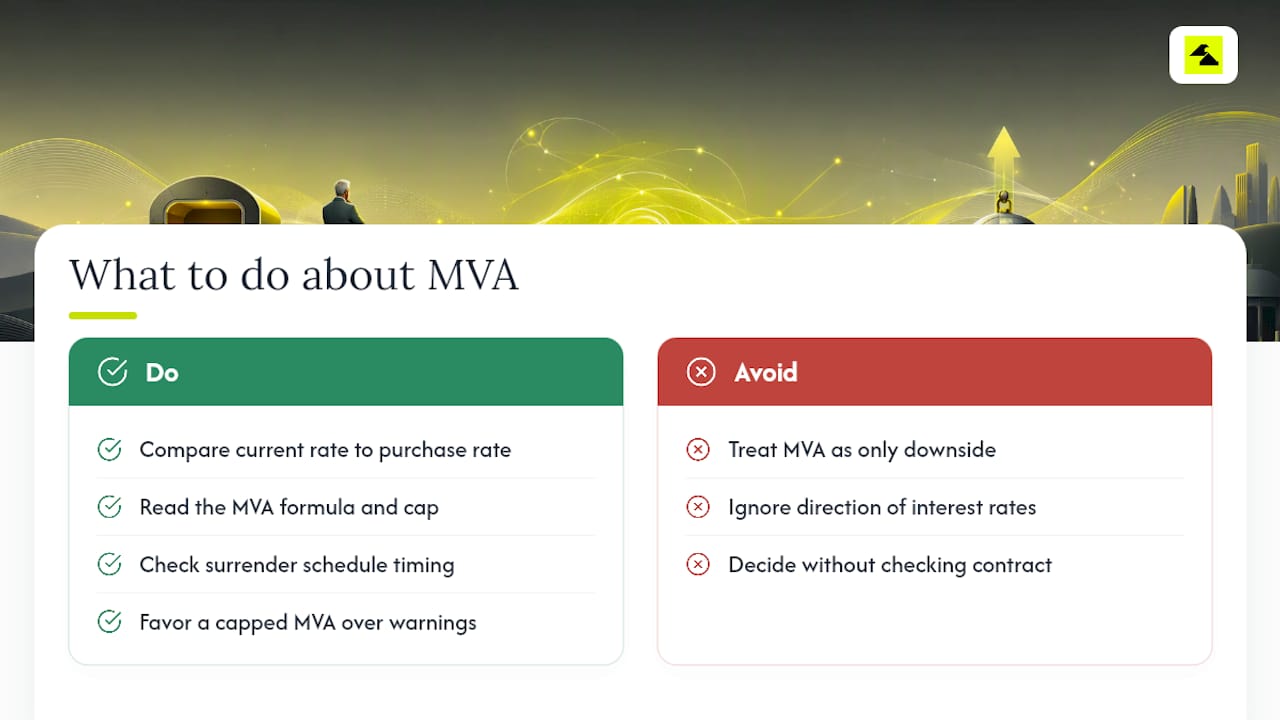
The bigger failure in conventional advice is timing blindness. Articles warn you about MVA in the abstract but rarely tell you to check the current rate direction against your purchase rate before deciding whether to wait out your surrender period or act now. That comparison, not the existence of the MVA clause itself, is what determines whether patience pays off.
Prioritize the contract’s actual formula over generic warnings. A cap on the downside matters more than the theoretical existence of a penalty. If your contract’s MVA is capped at 5% and your surrender charge is already scheduled to hit zero next year, the real math might favor waiting a few months rather than avoiding withdrawal altogether. Read the number, not the reputation.
— Jib Hunt
Get a Written Payout Estimate Before You Withdraw or Surrender
Instead of calling your carrier’s general line and hoping for a straight answer, you can get a document review and a net-payout estimate built around your actual contract.
[

If you’re weighing a withdrawal, start by requesting a written, dated example from your current carrier showing the surrender charge, MVA, and estimated tax impact together. Once you have that number, it can be reviewed against your contract language to determine whether a 1035 exchange or a different annuity structure fits your situation better, and quotes can be compared across carriers if you’re shopping for something new. You can compare annuity and life insurance quotes directly to get that process started.
This article is general information, not a substitute for advice from a qualified financial advisor. Consult a qualified financial professional about your own circumstances before acting on anything here.
Sources
FAQ
What does market value adjustment mean in an annuity?
It’s a contract feature that recalculates your surrender or withdrawal value based on how interest rates have shifted since you purchased the annuity, and it can raise or lower your payout depending on which direction rates moved.
What happens to the cash value of a market value adjusted annuity?
If current rates are higher than your purchase rate, the MVA typically reduces your cash value on amounts withdrawn beyond the free allowance; if rates are lower, it can increase that value, though most contracts cap the swing and protect a guaranteed minimum.
How much will a $100,000 annuity pay each month at age 60?
Monthly income depends heavily on the specific contract type, the payout option chosen, and current rates at the time of purchase, so there’s no single figure that applies across carriers; a written illustration from a specific carrier is the only reliable way to get that number.
What did Warren Buffett say about annuities?
Buffett has been publicly critical of high-fee, commission-heavy annuity products in past shareholder commentary, generally favoring low-cost index investing over complex insurance contracts for most investors, though his comments weren’t a blanket statement about every annuity structure or use case.
Recommended
SPIA vs MYGA: Which Annuity Fits Your Retirement?
MYGA Annuity Explained: Rates, Risks & How to Shop
Stop RMDs: How U.S. Tax Rules Treat Qualified vs Nonqualified Annuities
Recommended
Comments