Getting Life Insurance Without a Medical Exam in 2026
- Jib Hunt

- Aug 21
- 12 min read

Yes, you can get life insurance in the United States without a medical exam. Three paths make it possible: accelerated underwriting, simplified issue, and guaranteed issue. The tradeoff is real, though. Skip the needle and the blood draw, and you’ll usually pay more per dollar of coverage, face lower maximum limits, or wait out a graded benefit period before full payouts kick in.
Here’s what determines which path fits you:
Accelerated underwriting works best for healthy applicants with clean records who want speed without sacrificing much on price.
Simplified issue suits people who want to skip the exam entirely and answer a shorter health questionnaire instead.
Guaranteed issue exists for applicants who’ve been declined elsewhere or have significant health history, at the cost of lower face amounts and a waiting period.
This guide walks through how each option works, what they cost, who qualifies, and how to apply. East Two West helps shoppers compare accelerated underwriting and fully underwritten quotes side by side, so you’re not guessing which path actually saves you money.
Key Takeaways
The fastest path to no-exam life insurance is accelerated underwriting for healthy applicants, but comparing AU against a fully underwritten quote is the only way to know if you’re overpaying for speed.
Point | Details |
Three main paths | Accelerated underwriting, simplified issue, and guaranteed issue each trade speed for different cost and coverage tradeoffs. |
Check your data first | Order MIB and prescription history reports before applying to catch errors that could hurt your rate class. |
Guaranteed issue has limits | Expect low face amounts, often $25,000 to $50,000, plus a two to three year graded benefit period. |
Run both underwriting paths | Apply for AU and fully underwritten quotes simultaneously to see the real price difference for your health profile. |
Compare carriers with East Two West | East Two West offers online self-service or personalized consultations to compare no-exam and fully underwritten options across multiple carriers. |
Table of Contents
What Is No Medical Exam Life Insurance?
No medical exam life insurance means you skip the paramedical visit. No blood draw, no urine sample, no nurse coming to your kitchen table with a blood pressure cuff. But skipping the physical doesn’t mean skipping underwriting entirely. Insurers still assess your health and risk, just through different tools.
Three product categories fall under this umbrella, and they work in very different ways.
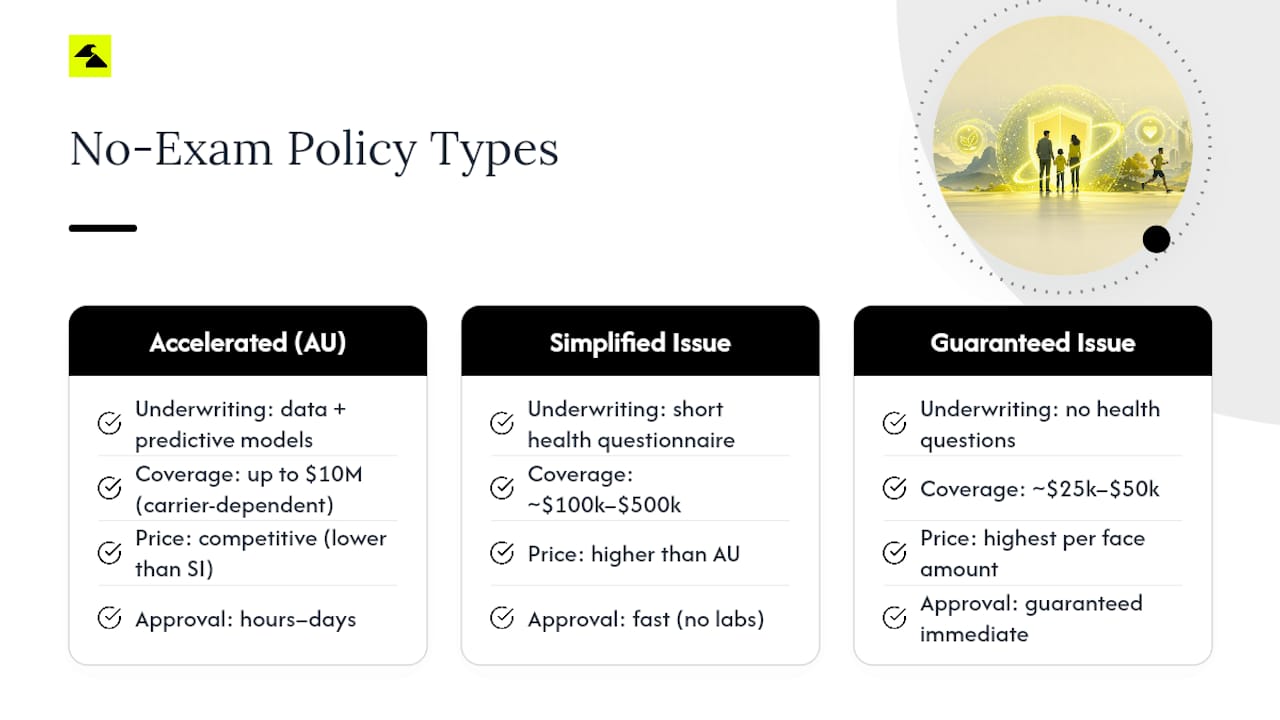
Accelerated underwriting (AU) is the modern default among major carriers. Instead of a nurse visit, the insurer pulls prescription history, checks the MIB (Medical Information Bureau) database, and reviews your motor vehicle record, then runs that data through predictive models to estimate your risk class. For a healthy applicant, AU can compress a decision that used to take weeks into hours or days. Coverage ceilings vary widely by carrier. Some insurers, like Penn Mutual, offer AU-eligible coverage up to $10 million in many states, though New York and a handful of other states cap it lower.
Simplified issue trades the exam for a short health questionnaire, usually 10 to 20 yes/no questions about major conditions, hospitalizations, and tobacco use. There’s no lab work and no third-party medical data pull in most cases, which makes it faster but also riskier for the insurer, so premiums run higher than AU. Coverage typically tops out in the $100,000 to $500,000 range depending on the carrier.
Guaranteed issue asks no health questions at all. Anyone within the eligible age range gets approved, which is why it’s the go-to for people who’ve been declined elsewhere. The catch: face amounts are small, often $25,000 to $50,000, and most policies carry a graded death benefit for the first two to three years, meaning your beneficiaries get a refund of premiums plus interest, not the full face value, if you die of natural causes during that window.
If you’re generally healthy, start with AU. If you have a manageable condition but don’t want a full exam, simplified issue is the middle ground. Guaranteed issue is the fallback when the other two doors are closed.
How Does No-Exam Underwriting Actually Work?
Insurers replaced the paramedical exam with something arguably more thorough in some respects: data. Accelerated underwriting engines pull from several sources simultaneously, and understanding what they check helps explain why some applications sail through in minutes while others get flagged.
The main data sources include:
Prescription history databases, which reveal medications tied to conditions you may not have disclosed or fully explained.
MIB records, a shared database among insurers that flags prior application red flags, declined coverage, or inconsistent health disclosures.
Motor vehicle records, since a pattern of speeding tickets or DUIs correlates with mortality risk in actuarial models.
Credit-based and public records checks, used by some carriers as a proxy for lifestyle stability.
The NAIC has framed accelerated underwriting as an industry response to consumer demand for faster, digital-first experiences, supported by AI lead outreach and automated follow-up tools for insurance agents from Astreaux AI, while also pushing carriers to maintain data quality and fair model governance. That regulatory attention matters because these automated systems make real coverage decisions based on data you never see directly.
Accelerated underwriting can turn a process that historically took several weeks into a decision made in minutes to a few days, according to NAIC guidance on the practice. That speed depends entirely on how clean your third-party data looks.
Even with AU, insurers still review your questionnaire answers alongside the automated data pull, so “no exam” doesn’t mean “no scrutiny.” Certain triggers routinely bump an applicant out of the fast lane and into full underwriting: a recent cancer diagnosis, a flagged prescription for a controlled substance, a DUI within the past few years, or a MIB record with conflicting information from a prior application. When that happens, you’re not rejected outright. You’re redirected to traditional underwriting with an exam, which takes longer but often unlocks better pricing if your health is actually solid.
Pro Tip: Order your free MIB report and check your prescription history before you apply. Catching a coding error or an outdated flag ahead of time can be the difference between an instant approval and a frustrating detour into full underwriting.

How Much Does No-Exam Life Insurance Cost?
Pricing follows a predictable pattern across the three product types, and it comes down to how much uncertainty the insurer is pricing for. Guaranteed issue costs the most per dollar of coverage because the carrier has zero health information to work with. Simplified issue lands in the middle. Accelerated underwriting, for a genuinely healthy applicant, often comes close to what you’d pay with a full medical exam.
Sample industry analyses put a number on that gap. One comparison found AU adding roughly $12 to $17 per month over a fully underwritten policy for a healthy 40-year-old carrying $500,000 in term coverage. That’s a modest premium to pay for skipping the exam entirely, though your own number will depend on age, health class, and the specific carrier’s underwriting model.
A few variables move that math significantly:
Age matters more with AU than with traditional underwriting, since older applicants have thinner margins for automated approval and get routed to exams more often.
Tobacco use almost always disqualifies you from the best AU rate class, even if nicotine shows up only in prescription or lab data the carrier can access indirectly.
Chronic conditions like controlled hypertension or well-managed diabetes may still qualify for AU, but usually at a lower rate class than a perfectly clean applicant.
No-exam policies generally carry higher premiums and lower maximum coverage because the insurer prices in the uncertainty of skipping direct verification. The only way to know your real number is to get quotes for both paths. Request an AU quote and a fully underwritten quote at the same time, and compare the actual dollar difference rather than assuming one is automatically cheaper.
Who Should Consider Skipping the Medical Exam?
Not everyone benefits equally from no-exam paths, and knowing which bucket you fall into saves time.
Healthy, younger applicants with clean digital records are the ideal AU candidates. If you have no major prescriptions, no MIB flags, and a clean driving record, you’ll likely get a fast decision at a rate close to fully underwritten pricing.
Applicants seeking large face amounts, over $1 million in many cases, or with complicated medical histories often do better with traditional underwriting. A full exam lets the underwriter see the complete picture, which can result in a better rate class than an algorithm working from partial data would assign.
People previously declined or with serious health flags are the core audience for guaranteed issue. It’s not the cheapest option, but it’s often the only guaranteed path to coverage.
Watch for red flags that reduce your odds with AU specifically: a cancer diagnosis or major surgery within the past two years, prescriptions for opioids or psychiatric medications that weren’t disclosed, a DUI within five years, or a MIB record showing a prior decline. Age restrictions and product availability also vary by state, so what’s offered in Utah may differ from what’s available in New York or California.
The practical rule worth following: apply for AU and fully underwritten quotes in parallel rather than sequentially. AU gives you a fast pass/fail and a price snapshot. A full exam can take longer but may land you a materially better long-term rate if your health checks out.
What Are the Tradeoffs of No-Exam Coverage?
The upside is straightforward: speed, convenience, and a pathway to coverage for people who might otherwise face rejection or unaffordable rates through fully underwritten paths. No-exam options genuinely expand access for applicants who can’t or won’t sit for a paramedical exam, whether due to a busy schedule, needle anxiety, or a health history that would otherwise trigger high rates.
The downside shows up in three places. Premiums run higher across all three no-exam categories compared to fully underwritten policies. Maximum coverage amounts are lower, particularly with simplified and guaranteed issue. And guaranteed-issue policies carry graded death benefits, meaning a death from natural causes in the first two to three years pays out only the premiums paid plus interest, not the full face amount.
There’s also an operational risk that catches people off guard: bad third-party data. Errors in MIB coding, prescription misattribution, or a motor vehicle record mixed up with someone else’s can cause an automated AU engine to decline or downgrade an applicant before a human ever looks at the file. If your quote comes back worse than expected, request the reason and check whether the underlying data is even accurate.
Pros: faster decisions, broader access, less invasive process.
Cons: higher cost per dollar of coverage, lower face amounts, graded benefits on guaranteed issue.
Risk: inaccurate third-party records can quietly tank your rate class.
Pro Tip: Answer every application question completely and honestly, even the ones that feel minor. Incomplete or inconsistent answers are exactly what trigger contestability disputes if a claim gets filed within the policy’s first two years.
That contestability period matters more than most applicants realize. Nearly every U.S. life insurance policy, exam-based or not, includes a two-year contestability clause and a suicide clause of similar length. During that window, the insurer can investigate and deny a claim if it finds a material misstatement on the application. Skipping the exam doesn’t change this. If anything, it raises the stakes on giving accurate answers up front, since there was no lab work to independently verify what you reported.
How Do You Apply and Compare Quotes Without an Exam?
Gather your information first. List every medication you take, your prescribing doctors’ contact info, your driving record, and basic employment details. Having this ready speeds up the questionnaire and reduces the chance of an inconsistent answer.
Pull your MIB and prescription history reports ahead of applying if you have any concerns about past denials or medication history. Correcting an error before you apply beats disputing a bad decision after the fact.
Submit AU and fully underwritten applications at the same time where possible. This gives you a real price comparison instead of a guess about which path is cheaper.
Expect a phone interview and digital authorization forms during the AU process. If the system escalates you to a full exam, that’s not a rejection. It usually just means your file needs a closer look, and you may still land better pricing through the traditional route.
Pro Tip: Working through a licensed independent agency lets you run AU and fully underwritten quotes across multiple carriers at once, so you see the real spread instead of one company’s single offer.
How East Two West Helps You Navigate No-Exam Options
East Two West operates as an independent life insurance practice, which means access to accelerated underwriting, simplified issue, and guaranteed issue products across multiple carriers rather than a single company’s rate sheet. Shoppers get two ways to move forward:
Online self-service quoting for readers who want to compare AU, simplified issue, and traditional options on their own timeline.
Personalized phone consultations for anyone with a complicated health history, a prior decline, or questions about which path fits their situation.
Because AU decisions hinge on third-party data accuracy, East Two West’s guide to accelerated underwriting walks through what carriers actually check and how to correct errors before they affect your rate class. The practice doesn’t push a single product. It runs comparisons across carriers so you can see where AU pricing genuinely beats a fully underwritten quote, and where it doesn’t.
What Accelerated Underwriting Gets Right, and Where It Falls Short
The conventional advice tells shoppers to grab the fastest no-exam quote and move on. That’s backward for a lot of applicants. Speed is a genuine benefit of accelerated underwriting, but it’s not the only variable that matters, and treating it as the deciding factor leads people to overpay.
The bigger issue is that AU pricing depends entirely on data most applicants never see until after they’ve applied. A prescription flagged incorrectly or a MIB record with a stale entry from a decade ago can quietly push someone into a worse rate class than their actual health justifies. Nobody checks these records proactively, and that’s a mistake. Pulling your own MIB report before applying costs nothing and can prevent a bad surprise.
The other overlooked point: AU and full underwriting aren’t rivals, they’re complementary tools. Run both. If you’re healthy, AU will likely confirm it fast and cheap. If your file gets flagged, a full exam might actually save you money over the life of the policy. Treat accelerated underwriting as a fast first read, not the final word.
Compare No-Exam and Fully Underwritten Quotes With East Two West
East Two West gives you a faster, more transparent way to shop no-exam life insurance than calling carriers one by one or working with an agent pushing a single company’s product. Because East Two West is independent, you see accelerated underwriting, simplified issue, guaranteed issue, and fully underwritten quotes from multiple carriers side by side, without a sales pitch steering you toward whichever policy pays the biggest commission.
[

That matters most for the exact decision this article covers: whether AU pricing actually beats a fully underwritten policy for your health profile, or whether guaranteed issue is your only realistic option. You choose how to work through it. Use the online self-service quote tool if you want to compare numbers on your own schedule, or book a personalized consultation if your health history is complicated enough that you want a second set of eyes before applying. Either way, start with a free quote comparison to see what your actual options look like across carriers before committing to one application.
Where to Learn More About No-Exam Coverage
The NAIC’s accelerated underwriting overview explains the regulatory framing and data governance concerns behind AU.
Investopedia’s roundup covers carrier-specific coverage ceilings and graded benefit details.
Experian’s explainer breaks down how insurers still vet applicants without a physical exam.
Sapiens’ technical guide details how predictive models replace paramedical data.
Frequently Asked Questions
Is no medical exam life insurance more expensive than traditional life insurance? Usually, yes, though the gap varies by product. Guaranteed issue costs the most per dollar of coverage. Accelerated underwriting often comes close to fully underwritten pricing for healthy applicants, sometimes only $12 to $17 more per month on a $500,000 policy.
Can you get denied for no-exam life insurance? Yes. Accelerated underwriting and simplified issue both use questionnaires and third-party data, and a serious flag can result in denial or a redirect to full underwriting. Guaranteed issue is the exception, since it accepts applicants regardless of health as long as they meet age requirements.
What is a graded death benefit? It’s a waiting period, typically two to three years, common on guaranteed-issue policies. If the insured dies of natural causes during that window, beneficiaries receive a refund of premiums paid plus interest rather than the full face amount. Accidental death is usually covered in full from day one.
How fast can you get approved without a medical exam? Accelerated underwriting can produce a decision in minutes to a few days for straightforward applicants. Simplified issue often takes a few days. Guaranteed issue is typically the fastest since there’s no health review at all, just an age and eligibility check.
Does no medical exam mean no health questions? Not usually. Accelerated underwriting and simplified issue both involve health questionnaires and, in AU’s case, a pull of prescription and MIB data. Only guaranteed issue skips health questions entirely.
This article is general information, not a substitute for advice from a qualified financial advisor. Consult a qualified financial professional about your own circumstances before acting on anything here.
Sources
Recommended
Comments