Owners: Avoid Hidden APL Debt in Premium Financing Life Insurance


Premium financing life insurance, in the Infinite Banking sense, means funding your own liquidity through a participating whole life policy’s cash value and policy loans, not through a bank. Done right, it lets business owners and investors borrow against a growing asset instead of pulling from a lender, with the death benefit and guarantees intact. It fits people with steady income, a long time horizon, and the discipline to repay what they borrow. Skip the repayment part, and the strategy turns against you fast.
TL;DR:
Policy loans generally have interest rates between 4 and 6 percent, with no credit check and quick funding, but excessive use can lead to unwanted loan balances.
Aggressive early funding with paid-up additions can accelerate cash value growth but risks triggering the IRS 7-pay limit, which could reclassify the policy as a tax-penalized MEC.
Unmanaged unpaid loan interest and repeated Automatic Premium Loan use can cause policy lapses and taxable gains if the loan balance surpasses the cash value.
A well-designed policy should include specific PUA-to-base-premium ratios, scheduled loan repayment rules, and annual reviews to prevent loan balances from overtaking cash value.
The strategy is most effective for owners and investors with predictable income and disciplined repayment habits, while improper underfunding and neglect explain most failures.
Table of Contents
How Policy Loans, APLs, and “Double Compounding” Actually Work
When you take a policy loan, the insurance carrier lends you money from its own general account. Your cash value stays put inside the contract, still earning guaranteed interest and, in a participating policy, still eligible for dividends. That’s the mechanic Infinite Banking practitioners call double compounding: your money keeps working while a separate loan balance runs alongside it.
A few things determine how well that arrangement actually performs:
Policy loans typically carry interest in the 4 to 6% range, with no credit check and funding that can arrive within days.
Direct recognition carriers may reduce the dividend paid on cash value that’s backing a loan; non-direct recognition carriers pay the same dividend regardless of outstanding loans.
The Automatic Premium Loan (APL) provision quietly pays your premium for you if you miss a payment, which prevents an immediate lapse but starts a debt clock you may not notice.
Pro Tip: Ask your carrier upfront whether APL is on by default. Plenty of policyholders find out it’s covering premiums for them only after several years of accumulated loans show up on a statement.
APL is the feature nobody reads the fine print on until it matters. It’s built to protect the policy from lapsing, but repeated use turns a temporary gap into a permanent balance that grows every year it’s untouched.
Policy Design: PUA, the 7‑Pay Test, and Realistic Timelines
The design lever that matters most is the Paid-Up Additions (PUA) rider. A policy funded mostly through base premium builds cash value slowly. One weighted toward PUAs builds it faster, because paid-up additions are essentially small chunks of fully paid insurance purchased with every extra dollar you contribute.
There’s a ceiling on how aggressively you can do this. The IRS’s 7-pay test caps how much premium you can pour into a policy in its first seven years before it gets reclassified as a Modified Endowment Contract (MEC). Cross that line and you lose tax-favored loan treatment. Our breakdown of the seven-pay test and MEC rules covers the mechanics in more depth.
Here’s what to expect on timing and cost:
Meaningful, borrowable cash value commonly shows up in 7 to 10 years, though heavy PUA funding can compress that somewhat.
Aggressive early funding raises complexity and requires closer monitoring against the 7-pay limit.
Early years carry higher relative cost. You’re paying commissions and building reserves before the policy’s compounding really kicks in, so patience is part of the price.
The Real Risk: When Loan Balances Outrun Cash Value
The math works against you when unpaid loan interest compounds faster than your cash value grows. That gap, left unmanaged, can push a policy into lapse, and a lapse with an outstanding loan larger than your basis creates a taxable gain. You lose the coverage and still owe the IRS.
Three things tend to cause this:
Repeated APL use. Each missed premium adds to the loan balance automatically, and without a manual check, it stacks year over year until it dwarfs the cash value backing it.
Borrowing without a repayment plan. Treating a policy loan like free money instead of formal debt is how practitioners have documented underwater policies turning into taxable surprises.
Ignoring dividend impact. On a direct recognition contract, an outstanding loan can lower the dividend credited to that portion of your cash value, slowing the very compounding you’re counting on.
Pro Tip: Pull your policy statement once a year and check the APL balance line specifically. It’s the number most people forget to look at until it’s grown large enough to matter.
Carrier selection helps here. Non-direct recognition contracts, favorable loan collars, and clear holdback terms all reduce the odds of this outcome. So does a written repayment schedule set the day you take the loan, plus an annual policy health review that stress-tests lower dividend scenarios against higher loan rates.
How to Evaluate and Implement an IBC Funding Plan
Start by defining what the money is for. Bridge capital for a specific purchase, recurring operating liquidity, or a long-term reserve each call for different funding levels and different repayment timelines.
Ask your carrier or agent for these before you sign anything:
The exact split between base premium and PUA allocation
Dividend illustrations run at best, expected, and conservative scales
Loan interest scenarios, including a stress test at a higher-than-current rate
Surrender charge schedule for the first 10 to 15 years
Documentation showing the policy passes the 7-pay test as designed
Then work through implementation in order:
Design the policy around your actual funding capacity, not the maximum the carrier will illustrate.
Fund it consistently. Sustained, disciplined contributions matter more than a large one-time deposit, since Infinite Banking works as a strategy, not a product that pays off on autopilot.
Put your loan repayment rules in writing before you ever take a loan, including amount, term, and what happens if cash flow tightens.
Confirm the APL default setting and who has authority to override it.
Schedule an annual review to check dividend performance against illustration and loan balances against cash value growth.
If loan proceeds fund business expenses, get your CPA to weigh in on interest allocation and possible deductibility under IRC §163. That’s a case-by-case call, not a blanket answer.
Where This Strategy Actually Works and Where It Gets Misused
The best fits are owners and investors with predictable income, repeat capital needs, and enough discipline to treat a policy loan the same way they’d treat a bank note. Someone running a business with seasonal cash flow gaps, or an investor who wants a standing pool of capital for opportunities, tends to get real value from a well-funded contract.
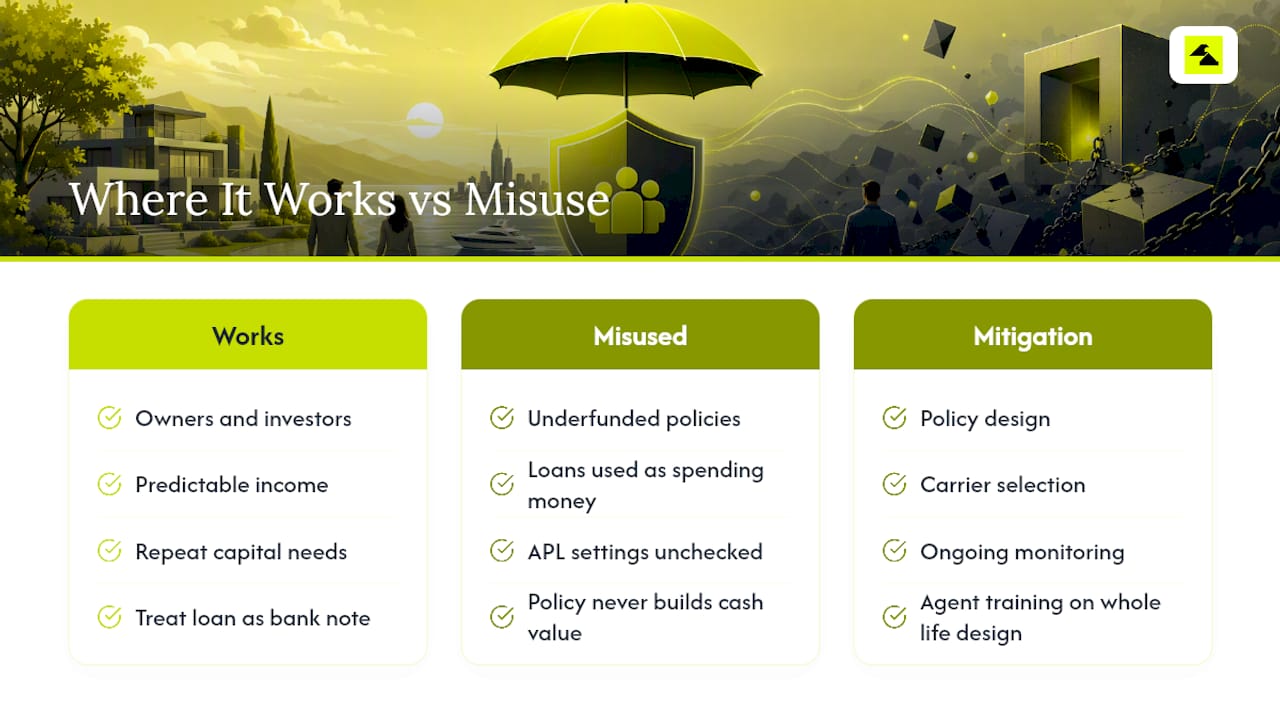
The misuse pattern is consistent. Underfunded policies that never build enough cash value, loans treated as spending money instead of debt, and APL settings nobody checked. Those three mistakes account for most of the “Infinite Banking didn’t work” stories you’ll hear.
We built our approach around policy design, carrier selection, and ongoing monitoring precisely because the mechanics reward patience and punish neglect in roughly equal measure. Our founder writes on this at length in The Capital Loop, and it’s the same framework East Two West uses when training agents on whole life design.
— Jib Hunt
Get a Policy Designed to Actually Support Your Liquidity Goals
Building a policy that can genuinely fund your liquidity needs takes more than picking a whole life product off a shelf. It takes deliberate design: the right PUA-to-base-premium ratio, a carrier whose loan and dividend terms fit your plans, and a 7-pay structure that holds up under IRS scrutiny.
[

Some insurance advisors work directly with business owners and investors on exactly this. That starts with an initial illustration review comparing carriers on dividend history, loan provisions, and direct versus non-direct recognition, moves into a funding plan sized to what you can sustain, and continues with scheduled policy health checks so loan balances never quietly outrun your cash value. If you’re weighing whole life against indexed universal life or trying to figure out whether permanent coverage makes sense for your situation, that’s a conversation worth having before you fund anything. Request a quote and we’ll walk through what a properly designed policy looks like for your numbers.
Sources
For readers who want to go deeper on specific mechanics referenced above:
This article is general information, not a substitute for advice from a qualified financial advisor. Consult a qualified financial professional about your own circumstances before acting on anything here.
FAQ
Is Premium Financing Life Insurance the Same as a Bank Loan?
No. As covered here, it means borrowing against your own whole life policy’s cash value through the insurer, not taking a third-party bank loan to pay premiums.
How Long Until a Policy Has Enough Cash Value to Borrow Against?
Meaningful, borrowable cash value typically emerges in 7 to 10 years, depending on how much of your funding goes toward paid-up additions.
What Happens if I Don’t Repay a Policy Loan?
Unpaid interest compounds against your cash value, and if the loan balance exceeds your basis when the policy lapses, the difference becomes taxable income.
What Is an Automatic Premium Loan and Why Is It Risky?
An APL automatically pays a missed premium from your cash value, preventing an immediate lapse, but repeated use builds a hidden loan balance that can grow for years unnoticed.
Can East Two West Help Design a Policy for This Strategy?
Yes. Some insurance advisors review carrier options, structure the PUA and base premium split, check 7-pay compliance, and set up ongoing monitoring for clients pursuing this approach.
Recommended
Comments