Book a Life Insurance Consultation: What to Expect
- Jib Hunt

- Aug 18
- 8 min read

A 30 minute call, usually over Zoom or phone, is enough to get a real answer on coverage: what type fits your situation, roughly what it costs, and what to gather before you apply. That is the entire point of a life insurance consultation. You are not committing to buy anything by scheduling one.
Leave the call with a tailored quote range, a recommendation (term vs. permanent), or a documented list of what underwriting will need.
A licensed insurance sales agent or consultant runs the call, comparing your situation against multiple carriers rather than pitching one product.
Quick reference: A healthy 40 year old can expect a $1 million, 20 year term policy to run about $86 a month for a woman and $109 for a man. Age and health move that number fast, which is exactly what a consultation clarifies before you apply. East Two West works this way, offering independent quotes across multiple carriers rather than a single company’s product line.
Key Takeaways
A short, fact-gathering consultation with an independent, multi-carrier advisor produces a tailored quote or a clear underwriting checklist faster than shopping one carrier alone.
Point | Details |
Book the right type | Match your goal, new coverage, policy review, business, or estate planning, to the right consultation type before scheduling. |
Expect fact-gathering first | Most calls run 20 to 45 minutes and prioritize your health and financial details before any product talk. |
Prepare your documents | Bring ID, income proof, current policy details, and a brief medical history to speed up underwriting. |
Know the real cost | A $1 million term policy runs about $86 to $109 a month for a healthy 40 year old; consultations themselves are typically free. |
Choose independence | East Two West compares quotes across multiple carriers through self-service or a 30 minute consultation, with compensation disclosed upfront. |
Table of Contents
What types of life insurance consultation should you book?
Not every consultation solves the same problem, and picking the wrong one wastes your time and the consultant’s. Here is how the main types break down:
New coverage. You have no policy yet and need help deciding between term (cheaper, temporary) and permanent (lifelong, builds cash value). Fits people buying their first policy around a mortgage, marriage, or new child.
Policy review or cash value analysis. You already own a policy and want to check whether it still fits your income, debts, or whether a whole life or indexed universal life policy is underperforming.
Business or succession planning. Owners use this to fund buy sell agreements or key person coverage so a partner’s death doesn’t sink the company.
Estate or legacy planning. High net worth families use permanent coverage to cover estate taxes or pass wealth efficiently to heirs.
Life settlement evaluation. For older policyholders who no longer need or can afford a policy and want to know if selling it for cash makes sense.
Annuity planning. Retirees weighing guaranteed income products, often alongside life coverage.
Pro Tip: If you already hold a policy, start with a review consultation before shopping new coverage. Half the time, the fix is adjusting what you have rather than buying something new.
How does a life insurance consultation actually work?
Most consultations run 20 to 45 minutes and follow a predictable arc: fact gathering first, coverage options second, next steps last. Nobody hands you a contract in minute five.
Here’s the typical sequence:
Pre screen. A few quick questions rule out obvious mismatches, like heavy tobacco use or a recent major diagnosis, before anyone invests time in a full review.
Questionnaire. You walk through health history, income, debts, dependents, and existing coverage.
Carrier suitability check. The consultant compares your profile against carrier underwriting guidelines, since insurers price risk very differently.
Recommendation. You get a specific product type and price range, not a vague “term is probably fine.”
Application support. If you’re ready, the consultant helps you complete paperwork and prep for any medical exam.
Fact gathering upfront is not a formality. Consultants who collect complete information before matching a carrier tend to see fewer underwriting surprises later, because the recommendation actually fits your risk profile.
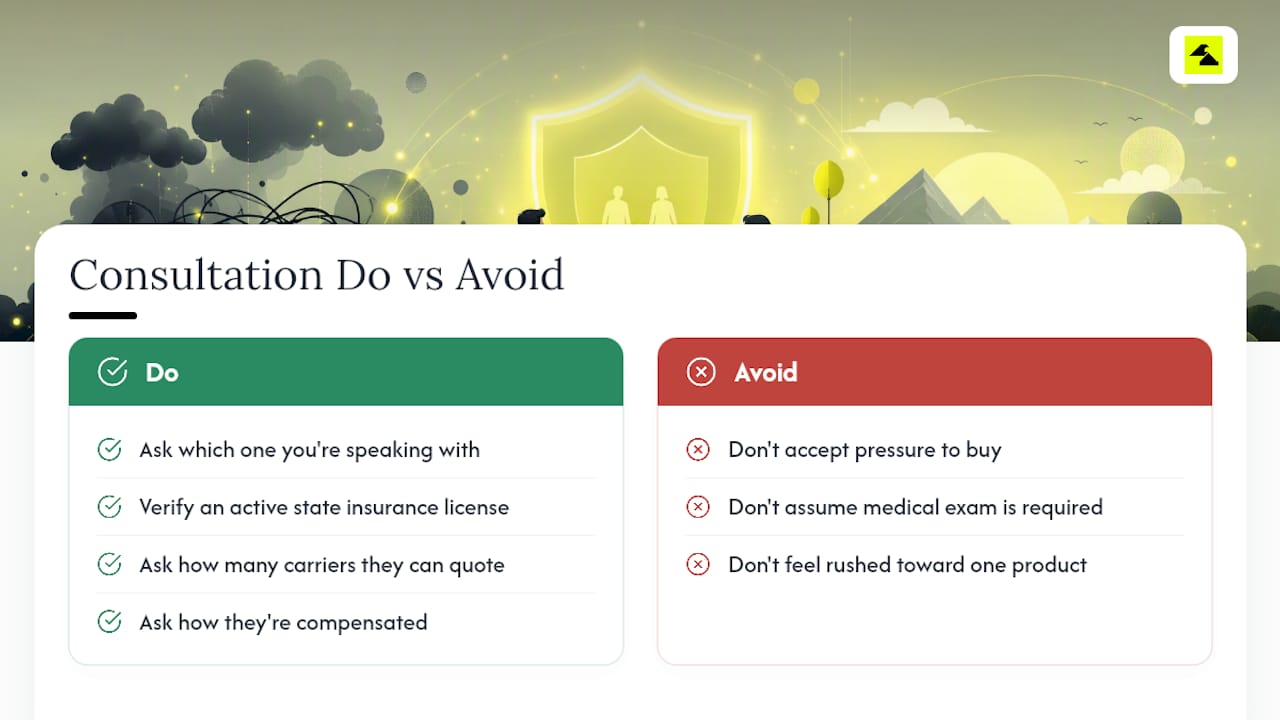
Worth knowing: a “consultant,” “agent,” and “broker” aren’t always the same thing legally. Some states draw a real line between someone who represents one carrier (agent) and someone licensed to shop multiple carriers on your behalf (broker or independent consultant). Ask directly which one you’re talking to.
What to look for during the call:
Clear disclosure of how the consultant gets paid
A license number you can verify
Access to more than one carrier, not just one company’s paperwork
Pro Tip: Ask “how many carriers do you have access to?” in the first five minutes. A one word answer tells you everything about whether you’re getting advice or a sales pitch.
How should you prepare for your consultation?
Bring a government ID, recent proof of income (pay stubs or a tax return), details on any current policy, your outstanding mortgage and debt figures, and a brief rundown of your medical history. That’s the short version. The longer version looks like a structured questionnaire covering five areas:
Personal identification (name, date of birth, address)
Health and medical history (conditions, medications, family history)
Lifestyle habits (smoking, alcohol, hazardous hobbies or occupations)
Financial liabilities (mortgage, debt, income, dependents)
Beneficiary details and coverage goals
A full version of this runs 35 to 45 questions, so don’t expect to wing it from memory.
Come with questions of your own, too: How are you compensated? How many carriers can you access? What’s your underwriting approach for someone with my health profile? What’s the realistic timeline from application to approved policy?
Pro Tip: Answer the deal breaker questions honestly and early, tobacco use, major diagnoses, DUI history. Pre-screening these upfront saves everyone from a long questionnaire that ends in a decline. Use encrypted upload links rather than email when sending sensitive documents.
Do consultations cost anything? No, most initial consultations are free. The consultant earns a commission from the carrier only if you actually purchase a policy.
What does a consultation cost, and how long does the whole process take?
Most initial consultations are free. The consultant’s income comes from a commission the issuing carrier pays after your policy is placed, not from a fee you pay directly, so ask upfront how that compensation works and whether it changes based on which carrier you choose.
The policy itself is where the real cost lives. A healthy 40 year old shopping a $1 million term policy can expect roughly $86 a month as a woman or $109 as a man for a 20 year term. Push the term length out or add a health issue, and that number climbs quickly. Some carriers now offer no-exam options even at the $1 million level, though you’ll still answer detailed health questions and the insurer may pull medical records.
Timeline runs roughly like this:
Consultation to application: same day to a few days
Application to underwriting decision: 2 to 6 weeks for traditional exams; days for accelerated no-exam programs
Underwriting to policy issue: typically 1 to 2 weeks after approval
Ask for a firm quote range during the call itself, not just a “we’ll follow up.”
Why work with an independent consultant instead of a single carrier?
An independent consultant can shop your health profile across multiple carriers instead of forcing you into one company’s underwriting box, and that difference shows up directly in your rate. Every carrier prices risk differently. Someone with a controlled health condition might get standard rates from one insurer and a decline from another.
That access changes the practical experience of buying coverage:
Broader quote comparison instead of a single take it or leave it number
No pressure to fit one product line, since there’s no quota tied to one carrier
Help prepping for a medical exam and filling out applications correctly the first time, which avoids re-underwriting delays
East Two West runs on this model: independent, multi carrier quotes with either self-service online quoting or a personalized phone consultation, whichever fits how you’d rather shop. The guidance stays the same either way, no sales pressure, just a comparison of what’s actually available for your profile.
Practitioner perspective: what consultants really focus on
Good consultants spend most of the call collecting accurate financial and medical facts, not talking about products. Clients are routinely surprised by that, expecting a pitch and getting a questionnaire instead. The most common mistakes I see are outdated beneficiary designations and coverage amounts that no longer match someone’s income or debt. The value of a real consultation is not the sales conversation. It’s leaving with a clear, honest number and a next step you can actually act on.

How do you book a consultation with East Two West?
East Two West gives you two ways to shop coverage: run your own numbers through the online quote form, or book a 30 minute phone or video consultation if your situation involves more moving parts, business planning, an existing policy review, or health history that needs a human to interpret.
[

Either path pulls quotes from multiple carriers instead of one, so you’re comparing real options rather than a single company’s rate card. If you book the consultation, the person on the call is paid by the carrier’s commission once a policy is placed, not by a fee you pay upfront, and that gets disclosed plainly before you ever discuss products. You’ll walk away with either a firm quote range or a clear list of what underwriting needs from you next. Start at East Two West and pick self-service or a scheduled call, whichever matches how much guidance you want.
Frequently asked questions about life insurance consultations
Is a life insurance consultation the same as talking to a salesperson? Not necessarily. An independent consultant compares multiple carriers and discloses compensation, while a single-carrier agent can only offer that company’s products. Ask which one you’re speaking with.
Do I need a medical exam to get a quote? Not always. Many carriers offer no-exam underwriting for coverage up to $1 million, though you’ll still answer detailed health questions and the insurer may review your medical records.
What qualifications should my consultant have? Look for an active state insurance license you can verify, plus clear answers about how many carriers they can quote and how they’re compensated.
How soon after the consultation can I get coverage? With accelerated, no-exam underwriting, approval can take days. Traditional underwriting with a medical exam typically takes two to six weeks before a policy is issued.
Will the consultant push me toward buying a policy? A consultation should end with options and next steps, not pressure. If you feel rushed toward one product, that’s a sign to ask more questions about their carrier access and compensation structure.
This article is general information, not a substitute for advice from a qualified financial advisor. Consult a qualified financial professional about your own circumstances before acting on anything here.
Sources
Recommended
Comments