What Life Insurance Do Business Owners Actually Need?
- Jib Hunt

- Aug 26
- 14 min read

Most business owners need two kinds of coverage working together: a policy that funds a buy-sell agreement and a policy that protects the business if a key person dies. Those are business jobs. A separate personal policy for family income replacement is a third, distinct need that shouldn’t get tangled up with the other two.
Here’s the tax tradeoff nobody explains clearly enough: premiums are generally not deductible under IRC §264(a)(1) when the business is the beneficiary, but the death benefit typically comes back income-tax-free, as long as the policy satisfies IRC §101(j) notice-and-consent rules. Miss that paperwork and the IRS can tax proceeds you assumed were clean.
Before any policy gets issued, sit down with a CPA and a business attorney to confirm who owns it, who pays the premium, and who’s named beneficiary. Then request quotes from more than one carrier.
Buy-sell funding protects ownership transitions when a partner dies, retires, or becomes disabled.
Key person coverage protects revenue and lender relationships if a critical employee or founder dies.
Personal life insurance replaces income for your family, separate from anything the business owns.
Pro Tip: Get your ownership and beneficiary structure reviewed before you shop for quotes, not after. Restructuring an already-issued policy is harder and sometimes triggers new underwriting.
TL;DR:
Business owners should regularly update and revalue buy-sell and key person policies every two to three years to ensure coverage keeps pace with company growth.
Proper ownership, premium payment, and beneficiary designations must be confirmed by a CPA and attorney before purchasing to avoid costly mistakes and tax issues.
Misunderstanding the tax rules, especially the need for written notice and consent under IRC §101(j), can turn otherwise tax-free death benefits into taxable income.
Selecting the right type of coverage depends on whether the need is short-term, like a bank loan, or long-term, such as indefinite buy-sell funding or balance-sheet reserves.
Comparing quotes from multiple carriers through an independent broker helps prevent carrier-specific underwriting restrictions from limiting coverage options.
Table of Contents
Types of Life Insurance for Business Owners: Term, Permanent, Group, and Individual
Ownership, Tax Treatment, and the 101(j) Trap That Costs Businesses Money
Life Insurance’s Role in Succession Planning Beyond the Buy-Sell Agreement
Using Life Insurance to Fund Employee Benefits and Executive Compensation
Legal Considerations by Business Structure: LLC, S-Corp, and C-Corp
Real-World Examples: How Coverage Structures Fit Different Businesses
What Actually Matters Most in Business Life Insurance Planning
Types of Life Insurance for Business Owners: Term, Permanent, Group, and Individual
Four product categories cover almost every scenario a small business runs into, and picking the wrong one is one of the most common expensive mistakes owners make.
Term life insurance pays a death benefit for a fixed period (10, 20, or 30 years) with no cash value. It’s the cheapest way to cover a temporary need, like a business loan with a set payoff date.
Whole life insurance is permanent, builds guaranteed cash value, and carries fixed premiums for life. Businesses use it when they want a coverage guarantee that never expires.
Indexed universal life (IUL) is also permanent, but cash value growth tracks a market index within limits. Some owners use IUL policies to build a supplemental reserve on the business balance sheet.
Group life insurance covers employees under one master policy, usually as a benefit, with modest death benefits and simplified underwriting.
Buy-sell funding and key person protection aren’t separate products. They’re ownership and use structures you apply to a term or permanent policy depending on the job.
Choose term when the need has an end date: a bank loan, a five-year growth plan, a partner nearing retirement.
Choose permanent when the need is indefinite: a founder who plans to run the company for 20-plus years, or a policy meant to double as a long-term asset.
Use group coverage for rank-and-file employee benefits, not for protecting the business itself.
Reserve individually owned policies for anyone whose loss would specifically hurt revenue, financing, or continuity.
How Do Buy-Sell Agreements Work With Life Insurance?
A buy-sell agreement is a contract that spells out what happens to a partner’s ownership stake if they die, become disabled, or want out. Life insurance is how most small businesses actually fund it, because without cash on hand, a surviving partner either can’t buy out the deceased partner’s family or has to take on debt to do it.
There are two structures. In a cross-purchase agreement, each owner personally buys and owns a policy on every other owner, and pays the premiums out of pocket. When one partner dies, the others use the payout to buy that partner’s shares directly. In an entity-purchase agreement, the business itself owns the policies, pays the premiums, and uses the proceeds to redeem the deceased owner’s shares. Entity-purchase is simpler with three or more owners, since cross-purchase requires a separate policy for every possible pairing.
Cross-purchase: owners own policies on each other; works cleanly with two or three partners.
Entity-purchase: the business owns and pays for policies on each owner; scales better with more partners.
Both structures need a current business valuation. Values from five years ago rarely reflect what the company is worth today.
Pro Tip: Rerun your business valuation every two to three years, or whenever revenue shifts significantly, and update the buy-sell agreement’s funding amounts to match. An outdated valuation defeats the purpose of the agreement.
Have your attorney draft or update the agreement itself and your CPA confirm tax treatment. Investopedia’s overview of buy-sell agreements covers the mechanics of both funding structures in more depth.
What Is Key Person Insurance and How Much Do You Need?

Key person insurance is a policy the business owns on someone whose death would cause real financial damage: a founder, a top salesperson, or a specialist whose relationships or skills can’t be replaced quickly. The Insurance Information Institute defines it specifically as coverage against measurable financial harm from losing that person, not a general benefit like group life.
A person qualifies as “key” if their departure would meaningfully hurt revenue, if a lender requires their coverage as a loan condition, or if replacing them would take months and cost real money in recruiting and training.
Three sizing methods work well together, and using more than one strengthens your case with underwriters:
Multiple of compensation. Take the person’s salary and multiply by 5 to 10, depending on their role’s impact.
Revenue contribution. Estimate two to three years of revenue tied directly to that person and use it as your target face amount.
Replacement cost. Add up recruiting fees, signing bonuses, training time, and lost productivity during the search.
A worked example: a founder earning $150,000 a year, whose departure would also threaten a client relationship worth $400,000 in annual revenue, might justify coverage in the $750,000 to $1.2 million range once you blend the compensation multiple with a partial revenue estimate. Documenting that math matters because sizing methodology needs to hold up if a lender or later reviewer asks why you chose that number.
For key employees whose disability would hurt the business just as much as their death, consider pairing key person life insurance with a business disability policy. Death isn’t the only way you lose someone.
Ownership, Tax Treatment, and the 101(j) Trap That Costs Businesses Money
Two tax rules govern almost every business-owned policy, and getting either one wrong is expensive.
The first is IRC §264(a)(1), which disallows a deduction for premiums whenever the business is directly or indirectly the beneficiary. You don’t get to write off the cost of key person or entity-purchase premiums. That’s the price of the death benefit typically coming back income-tax-free.
The second is IRC §101(j), and this is where businesses get burned. For any policy issued after August 17, 2006, on an employee (which includes owners and partners who work in the business), the employer must give that person written notice before the policy is issued and get their written consent to be insured, including disclosure of the coverage amount. The business must also file Form 8925 annually reporting how many employer-owned policies it holds and confirming compliance. Skip either step, and the IRS can treat the entire death benefit as taxable income instead of tax-free.
Employer-owned life insurance issued without proper notice and consent loses its tax-free treatment entirely. There’s no partial penalty. The business either complies fully before the policy is issued, or the death benefit becomes ordinary taxable income when it’s needed most.
Common mistakes include issuing the policy before getting signed consent, forgetting Form 8925 in later tax years, and failing to review coverage when a covered employee leaves the company. If someone insured under an employer-owned policy departs and more than 12 months pass before their death, the business can lose tax-free treatment on that policy unless a specific exception applies.
Get written notice and consent signed before the policy is issued, not after.
File Form 8925 every year you hold an employer-owned policy.
Review legacy policies whenever a covered employee leaves.
Loop in both a CPA and a business attorney before finalizing ownership and beneficiary designations.
Term vs. Permanent Coverage for Business Insurance Needs
Term insurance costs less because it expires. Permanent insurance costs more but builds cash value you can borrow against and never lapses as long as premiums are paid. For most business insurance jobs, the choice comes down to whether the need has a deadline.
Permanent coverage tends to make sense when a business wants a policy that also functions as a long-term balance-sheet reserve, when it’s funding deferred executive compensation that will pay out decades from now, or when a founder intends to hold their ownership stake indefinitely and wants buy-sell funding that never needs renewing.
Term is the right, low-cost answer for a five-year bank loan guarantee, a key person policy on someone expected to retire in a decade, or any coverage tied to a specific, foreseeable end date.
Permanent policies fit long-horizon needs: indefinite buy-sell funding, executive compensation, balance-sheet reserves.
Term policies fit finite needs: loan terms, short-term key person gaps, temporary buy-sell bridges.
Many businesses stack both: term for a loan covenant, permanent for the founder’s long-term buy-sell funding, layered on the same person.
Reevaluate the mix every few years as loans get paid off and the business matures.
Riders and Beneficiary Design That Change the Outcome
A few optional riders matter more for business-owned policies than personal ones. Waiver of premium keeps a policy active if the payer becomes disabled. Accelerated death benefit riders let a terminally ill key person or partner access funds early. Return of premium riders refund premiums if the insured outlives the term, useful for cost-conscious owners.
Beneficiary designations must match the buy-sell agreement exactly, since a mismatch can void the funding intent entirely.
Trusts sometimes hold policies in estate-focused structures, particularly for larger ownership transitions.
Cross-purchase arrangements require each owner’s policy to name the correct co-owner, not the business.
How to Get the Right Business Life Insurance Coverage
Identify each job the coverage needs to do (buy-sell, key person, or personal) and treat them separately.
Size coverage for each job using the multiples above, and write the math down.
Confirm ownership, payment, and beneficiary structure with a CPA and attorney.
Complete notice, consent, and Form 8925 paperwork before any employer-owned policy is issued.
Request three to five quotes across carriers rather than accepting the first offer.
Underwriters typically ask for financial statements, a valuation for buy-sell policies, and health records; expect a few weeks for standard underwriting or faster turnaround with accelerated programs.
Pro Tip: An independent broker like East Two West can pull quotes from multiple carriers at once, which matters more for business policies than personal ones because underwriting appetite for key person and buy-sell coverage varies a lot carrier to carrier.
Life Insurance’s Role in Succession Planning Beyond the Buy-Sell Agreement
A buy-sell agreement handles ownership transfer between living partners, but succession planning covers more ground than that. When a business owner dies and the company passes to heirs rather than co-owners, estate taxes can force a fast, undervalued sale just to cover the tax bill. Life insurance proceeds paid outside the estate, or structured with proper trust ownership, give heirs cash to pay estate obligations without liquidating the business itself.
Continuity strategy is the other half. If the founder is also the person who holds key banking relationships, signs every major contract, or is the face of the company to customers, the business needs a bridge plan for the months after that person’s death, not just a payout. Some owners use permanent life insurance cash value as an accessible reserve during that transition window, on top of whatever buy-sell or key person proceeds arrive.
Family-owned businesses face a particular version of this problem: multiple heirs, only one of whom wants to run the company. Life insurance can equalize inheritances, giving the non-active heirs a cash payout while the active heir keeps the business, instead of forcing a sale or a messy buyout negotiation years after the fact. That only works if the policy amount and beneficiary designation are set up years in advance, not decided during probate.
Using Life Insurance to Fund Employee Benefits and Executive Compensation
Beyond protecting against a death, life insurance is a common funding vehicle for benefits a business wants to offer key employees without immediate cash outlay. Deferred compensation plans, where a business promises to pay an executive a benefit years down the road, often use permanent life insurance cash value as the informal funding source. The business owns the policy, pays premiums, and can access cash value to help meet the deferred payout obligation when it comes due, while the death benefit provides a backstop if the executive dies before then.
Split-dollar arrangements work similarly: the business and an executive share the cost and benefit of a policy, with the specifics of who gets what spelled out in a separate agreement. These plans reward retention. An executive who leaves early might forfeit some or all of the arrangement, which gives key people a financial reason to stay.
Group carve-out plans use a different logic. Instead of accepting a modest standard group life benefit, the business carves out its most valued employees and provides them supplemental, individually owned coverage instead, often as a resettable retention tool tied to tenure or performance.
None of these structures deduct premiums under the same §264(a)(1) restriction that governs key person coverage when the business is beneficiary, so run every executive comp idea past your CPA before promising it to anyone.
Legal Considerations by Business Structure: LLC, S-Corp, and C-Corp
The entity type your business operates under changes some of the mechanics, even though the core tax rules apply across the board.
LLCs taxed as partnerships often use cross-purchase structures naturally, since individual members already file taxes similarly to sole proprietors. Multi-member LLCs with more than a few partners tend to favor entity-purchase for simplicity, with the LLC itself owning policies on each member.
S-corps add a wrinkle: premium payments on officer life insurance where the corporation is beneficiary aren’t deductible, and how those premiums flow through shareholder basis needs specific attention from a CPA familiar with S-corp accounting. Shareholder-employee notice and consent under §101(j) still applies the same way it would for any employer-owned policy.
C-corps face the same non-deductibility rule, but because C-corps pay their own corporate tax, the interaction between premium payments, retained earnings, and eventual death benefit receipt runs through corporate accounting differently than a pass-through entity. Larger C-corps funding executive deferred compensation with life insurance also need to track this on their balance sheet correctly.
Across every structure, the notice-and-consent and Form 8925 requirements apply identically. Entity type doesn’t create an exception to §101(j) compliance, only differences in how the deduction and basis questions get handled on the tax return.
Real-World Examples: How Coverage Structures Fit Different Businesses
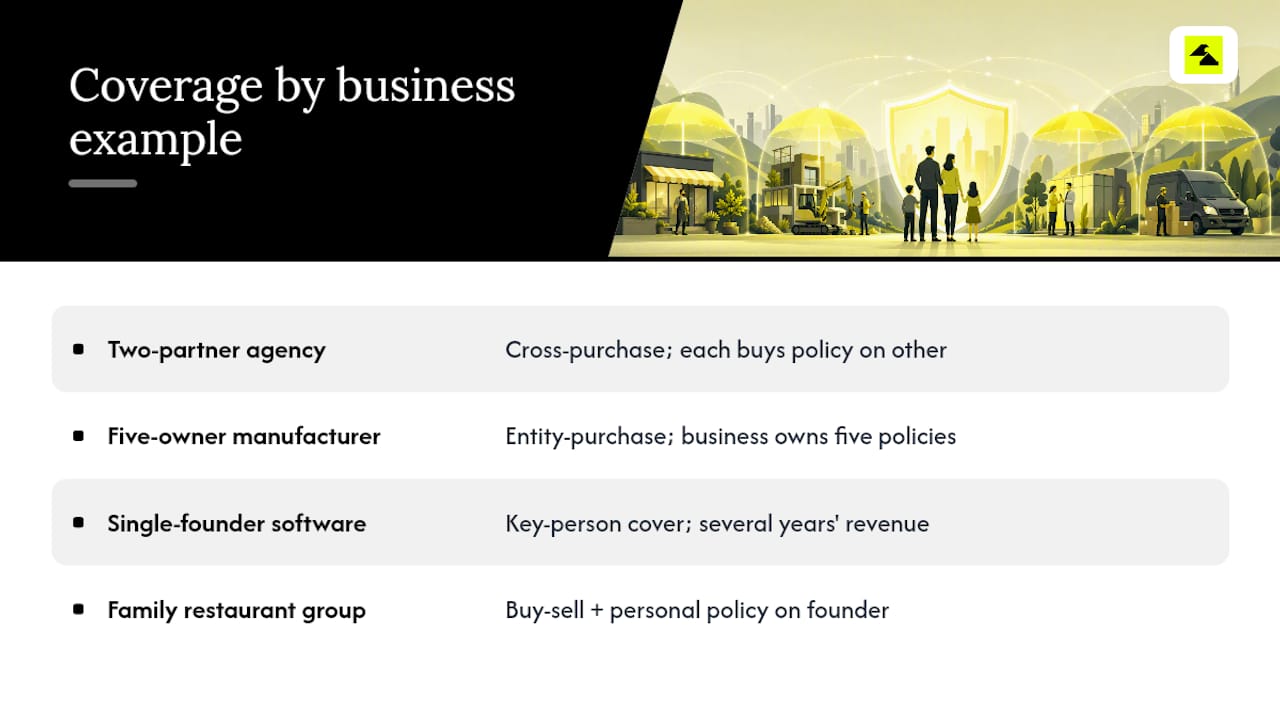
A two-partner marketing agency with roughly equal ownership is a textbook cross-purchase case. Each partner buys a policy on the other, sized to that partner’s share of the business valuation, so a surviving partner can buy out a deceased partner’s family directly and keep full control without bringing in an outside buyer.
A five-owner manufacturing company usually points toward entity-purchase instead. Cross-purchase among five owners would require ten separate policies; entity-purchase needs only five, with the business owning and paying for each one, then redeeming shares as owners exit.
A software company built around one technical founder is a key person case more than a buy-sell case. If that founder holds most of the client relationships and technical knowledge, a key person policy sized at several years of the revenue tied to that founder gives the business a cash runway to hire a replacement or wind down gracefully rather than collapsing overnight.
A family-owned restaurant group with three siblings, only one of whom is active in daily operations, often combines a modest buy-sell agreement with a larger personal policy on the parent-founder, using the personal proceeds to equalize the inheritance for the two non-active siblings while the active sibling keeps the business itself.
Each of these businesses needed a different structure because the ownership shape and the specific financial risk were different, not because one product is better than another.
Mistakes Business Owners Make With Life Insurance Planning
The single most expensive mistake is treating life insurance as a one-time purchase instead of a structure that needs maintenance. A buy-sell agreement funded five years ago at a $2 million valuation is badly underfunded if the business is now worth $5 million, and nobody notices until a partner dies and the payout falls short.
Skipping the notice-and-consent paperwork under §101(j) is the second most common and most costly error, since it can turn a tax-free death benefit into fully taxable income at the exact moment the business needs the cash most.
Other recurring mistakes: naming the wrong beneficiary on a cross-purchase policy (naming the business instead of the co-owner defeats the structure), letting coverage lapse after a covered employee leaves without reviewing the policy, mixing personal and business insurance needs into a single policy instead of sizing them separately, and skipping a CPA and attorney review because the process feels straightforward. It rarely is once ownership, tax, and estate considerations overlap.
What Actually Matters Most in Business Life Insurance Planning
Most guidance on this topic front-loads product comparisons: term versus whole life, carrier ratings, rider options. That’s not where businesses actually lose money. They lose money on structure. An underfunded buy-sell agreement, a missed §101(j) consent form, a beneficiary designation that contradicts the operating agreement. Those mistakes don’t show up until someone dies, which is exactly the wrong time to discover a paperwork gap.
If you take one thing from this guide, make it this: size your coverage second and structure it first. Decide who owns each policy, who pays the premium, and who’s named beneficiary before you request a single quote. That sequence prevents almost every expensive mistake covered above.
The conventional advice to “just get key person insurance” undersells how much the sizing math and the paperwork trail matter to a lender, a future buyer, or the IRS. A face amount you can’t justify in writing is a liability disguised as protection.
Get your CPA and attorney to sign off on structure first, then shop multiple carriers for the actual policy. An independent broker exists precisely because carrier appetite for business coverage varies enough that a single quote rarely tells you the full picture.
— Jib Hunt
East Two West: Comparing Business Coverage Without the Sales Pressure
East Two West is the independent alternative to calling a single captive agent and taking whatever policy they push. As an independent broker, East Two West pulls quotes across multiple carriers for buy-sell funding, key person coverage, and personal policies, so you’re comparing real pricing instead of one company’s product lineup.
[

That independence matters specifically for business coverage, where carrier underwriting appetite for key person and entity-owned policies swings widely. A captive agent can only offer what their one company underwrites. East Two West also helps you think through ownership and payment structure before you apply, which is exactly where the §101(j) mistakes covered above tend to happen.
Choose your own path: compare quotes online at your own pace, or talk through a more complex ownership structure with a licensed advisor. Either way, get a quote started today and bring the results to your CPA and attorney before you sign anything.
Key Takeaways
Business owners need separate policies for buy-sell funding, key person protection, and personal income replacement, with ownership structure confirmed before purchase to preserve tax-free death benefits.
Point | Details |
Separate the three jobs | Buy-sell funding, key person protection, and personal coverage each need their own policy and sizing math. |
Premiums aren’t deductible | Under IRC §264(a)(1), premiums aren’t deductible when the business is beneficiary, but proceeds are typically tax-free if compliant. |
Complete §101(j) paperwork first | Get written notice and consent signed before policy issue, and file Form 8925 every year you hold employer-owned coverage. |
Revalue and re-size regularly | Update business valuations and key person coverage every two to three years so funding keeps pace with growth. |
Compare carriers independently | East Two West provides multi-carrier quotes with online self-service or consultation, so you compare pricing before committing to a policy. |
Where to Verify the Tax and Regulatory Details
IRS rules on employer-owned life insurance and Form 8925 govern tax compliance.
SBA’s business insurance guide and NAIC’s consumer resource cover policy types and protections.
NerdWallet’s coverage guide helps with shopping and sizing comparisons.
This article is general information, not a substitute for advice from a qualified financial advisor. Consult a qualified financial professional about your own circumstances before acting on anything here.
Sources
Recommended
Comments