Term Life Insurance Cost: What You'll Pay and How to Lower It
- Jib Hunt

- Aug 12
- 11 min read

A 40-year-old nonsmoker buying a 20-year, $500,000 term policy pays about $47/month if female and $59/month if male. That’s the middle of the range. A healthy 25-year-old can get the same coverage for under $25/month. A 55-year-old smoker might pay four times that. Three things explain most of the variance: how old you are when you apply, whether you use tobacco, and how much coverage you buy.
$47–$59/month is the national average for a 40-year-old nonsmoker on a 20-year, $500,000 term policy.
The fastest way to find your actual number is to run a multi-carrier quote with your real age and health profile. The rest of this article shows you exactly what moves that number and how to push it lower.
Key Takeaways
Term life insurance costs are predictable once you understand the inputs: your age at application, tobacco status, health class, coverage amount, and term length are the five levers that move the number most.
Point | Details |
Age drives cost more than anything | A 25-year-old pays roughly half what a 40-year-old pays for the same $500K, 20-year policy. |
Smokers pay 2–3x more | Any nicotine use in the prior 12 months triggers smoker rates; quitting for 12+ months requalifies you. |
Rate class spreads are large | The gap between Preferred Plus and Standard can reach 78–93% at many issue ages. |
Shop multiple carriers | Underwriting leniency varies by condition; the cheapest quote for your profile depends on which carrier favors your health history. |
East Two West compares carriers for you | Independent multi-carrier quoting online or by phone, with no direct client fee. |
Table of Contents
How term length, coverage amount, and riders change your premium
How to compare quotes properly and why underwriting differences matter
What to expect when your term ends: renewal, conversion, and costs
From application to issued policy: what the timeline looks like
East Two West’s approach to finding competitive term life pricing
How insurers calculate term life insurance cost
Underwriting is the process insurers use to decide how much risk you represent and what to charge for it. Every application goes through a set of filters, and the output is a rate class that determines your premium.
The main underwriting inputs:
Age — the single biggest driver; premiums rise steeply after 45–50
Gender — women statistically live longer, so they pay less; CDC mortality data underpins these assumptions
Tobacco and nicotine use — any use in the prior 12 months typically triggers smoker rates
Medical history — diagnosed conditions, hospitalizations, surgeries
Current medications — some drugs signal conditions underwriters price separately
Family history — parents or siblings with early-onset heart disease or cancer
Occupation — commercial fishing, logging, and roofing carry higher mortality risk
Hobbies — skydiving, scuba diving, and motorsports can add a flat extra or table rating
Driving record — DUIs or multiple moving violations in the past 3–5 years
BMI and blood pressure — outside normal ranges often push you to a lower class
Rate classes: the tier that sets your price
Most carriers use four to five tiers. The names vary slightly, but the structure is consistent:
Rate Class | What It Means |
Preferred Plus / Elite | Near-perfect health, clean family history, ideal BMI |
Preferred | Minor issues allowed; most healthy adults qualify |
Standard Plus | Some health history or borderline metrics |
Standard | Average health; the baseline most tables quote |
Substandard / Table-Rated | Significant health conditions; flat extras or table ratings applied |
Rate-class spreads between Preferred Plus and Standard can create a substantial difference in monthly premiums depending on issue age. That gap is why two people with the same coverage amount and term length can get quotes that look nothing alike.

Pro Tip: If you’re in good health but haven’t had a physical recently, a fully underwritten policy with a medical exam often lands you in a better rate class than accelerated underwriting, which uses algorithms and may be more conservative. Learn more about accelerated underwriting to decide which path fits your profile.
Insurers also build in expense loading (administrative costs, agent commissions, profit margin) on top of the mortality cost. That’s why two carriers can price the same applicant differently even when their mortality tables are similar. Their internal expense structures and target markets differ.
Sample monthly costs by age, coverage, and smoker status
The figures below reflect level-term, 20-year policies for nonsmokers and smokers at common ages and coverage amounts. Rates are consolidated from publicly published carrier data and aggregated rate files; actual quotes will vary by carrier, state, and individual health profile.
Assumptions: 20-year level-term policy, standard health class unless noted, rates in USD/month. Sources: MoneyGeek, NerdWallet, InsuranceGeek.
Smokers typically pay 2–3 times more than nonsmokers for comparable coverage, and the gap widens with age.
A few things stand out in those numbers. The jump from age 40 to 50 is steep, often doubling the monthly cost for the same policy. And the smoker penalty at age 60 is severe enough that quitting tobacco before applying can save more money over a 20-year term than almost any other single action.
How term length, coverage amount, and riders change your premium
Term length trade-offs
Longer terms cost more per month because the insurer is on the hook for a longer window of mortality risk. But the math isn’t always straightforward.
10-year term: Lowest monthly cost; useful if your largest liability (a mortgage, a business loan) expires soon
20-year term: The most common choice; covers the years when dependents are most financially exposed
30-year term: Higher monthly cost but locks in today’s rate for three decades; often the right call for buyers in their 30s with young children
Buying two consecutive 10-year policies instead of one 20-year policy almost always costs more in total, because your second policy prices you at your older, less healthy self. Locking in a longer term now is usually cheaper than renewing later.
Coverage amount scaling
Doubling coverage from $500,000 to $1,000,000 does not double the premium. For a 40-year-old male nonsmoker, the jump from $500K to $1M adds roughly $53/month, not $59. That’s because fixed underwriting costs spread across a larger face amount. If you’re debating between $500K and $750K, the incremental cost is often small enough to justify the higher coverage.
Riders that add cost (and when they’re worth it)
Waiver of premium — keeps the policy in force if you become disabled; adds a modest monthly cost and is worth considering for anyone without robust disability coverage
Child rider — covers all children under one flat premium; typically inexpensive and convenient
Return of premium (ROP) — refunds all premiums if you outlive the term; can double the monthly cost and rarely pencils out as an investment
Accelerated death benefit — pays a portion of the death benefit early if you’re diagnosed with a terminal illness; many carriers include this at no extra charge
Pro Tip: Match your term length to your largest liability. If you have 22 years left on a mortgage, a 25-year term covers it with a buffer. A 20-year term that expires while you still owe $180,000 on the house leaves a gap.
Practical steps to reduce your term life insurance premium
Most of the factors that drive up premiums are either fixed (age, gender) or slow to change (family history). But several are genuinely within your control.
Buy sooner rather than later. Rates rise with every birthday. Locking in a policy at 35 instead of 40 can save hundreds of dollars per year over a 20-year term.
Quit tobacco for at least 12 months. Insurers classify you as a smoker based on any nicotine use in the prior 12 months. After a full year clean, you can apply for nonsmoker rates, which typically cuts your premium by half or more.
Improve measurable health metrics. Blood pressure, cholesterol, and BMI all feed directly into rate class decisions. A few months of consistent effort before applying can move you from Standard to Preferred.
Shop multiple carriers. Underwriting guidelines differ significantly between companies. One carrier may be lenient on well-controlled hypertension; another may table-rate the same applicant. Comparing quotes across carriers is about finding the one most favorable to your specific profile, not just the lowest list price.
Right-size your coverage. Buying more coverage than you need costs money. Run a quick needs analysis: income replacement (typically 10–12x annual income), outstanding debts, and future obligations like college tuition.
Consider accelerated underwriting for healthy profiles. If you’re under 50 and in good health, no-exam policies can issue in days rather than weeks, sometimes at competitive rates.
Pro Tip: If you’ve recently lost significant weight or quit smoking, wait until you can document the change before applying. An insurer will use your current metrics, not your projected ones. Six months of sustained improvement is worth more than a promise.
How to compare quotes properly and why underwriting differences matter
Getting five quotes and picking the cheapest number is the wrong approach. Here’s a process that actually works.
Fix the variables first. Same coverage amount, same term length, same riders across every quote. Comparing a $500K policy with a waiver of premium rider to a bare $500K policy is comparing apples to oranges.
Disclose everything accurately. Misrepresenting health history doesn’t lower your rate permanently; it creates a contestability risk that can void the policy when your family needs it most.
Ask about rate class assumptions. An online quote engine often defaults to Preferred or Preferred Plus. If your health profile is Standard, the real number will be higher. Know which class the quote assumes.
Identify carrier-specific leniency. Carriers have internal guidelines that treat the same condition differently. One carrier may offer Preferred rates to a 45-year-old with well-controlled Type 2 diabetes; another may decline the application entirely. Comparing multiple carriers is the only way to surface this.
Account for the full underwriting process. A quoted rate can change after the medical exam and APS (attending physician statement) review. Ask the agent what conditions would trigger a rate change and by how much.
Use an independent broker or multi-carrier quoting tool. A captive agent represents one company. An independent practice accesses multiple carriers and can steer you toward the one whose underwriting guidelines best fit your health profile.
Pro Tip: If you have a specific condition (sleep apnea, a past cancer diagnosis, controlled hypertension), ask the broker which carriers are currently most lenient for that condition before submitting a formal application. A formal application triggers a hard inquiry on your MIB record; too many in a short window can complicate subsequent applications.
What to expect when your term ends: renewal, conversion, and costs
Most people don’t think about this until the policy is about to expire. By then, options narrow and costs rise.
Annual renewable term (ART) renewal: When a level-term policy expires, most carriers offer a year-by-year renewal. The catch is that the renewal rate is based on your current age, not the age when you first bought the policy. A 60-year-old renewing a policy originally bought at 40 will see a dramatic price jump, often making renewal impractical for large face amounts.
Conversion to permanent coverage: Most term policies include a conversion privilege that lets you switch to a permanent policy (whole life, universal life, or indexed universal life) without a new medical exam. You convert at your current age, so the permanent policy costs more than the term did, but you lock in insurability regardless of any health changes since the original issue.
Your practical options at term end:
Renew year-to-year — works for short-term bridge coverage; expensive for multi-year needs
Buy a new term policy — only viable if your health is still good; you’ll go through full underwriting again
Convert to permanent — higher monthly cost but guaranteed coverage and potential cash value growth
Let the policy lapse — appropriate if your financial obligations have wound down and dependents are self-sufficient
If your health has deteriorated since you bought the original policy, conversion is often the only path to continued coverage at a predictable cost. The conversion window typically closes at a specified age (often 65–70) or at the end of the term, whichever comes first. Missing it means starting over with full underwriting at your current health status.
From application to issued policy: what the timeline looks like
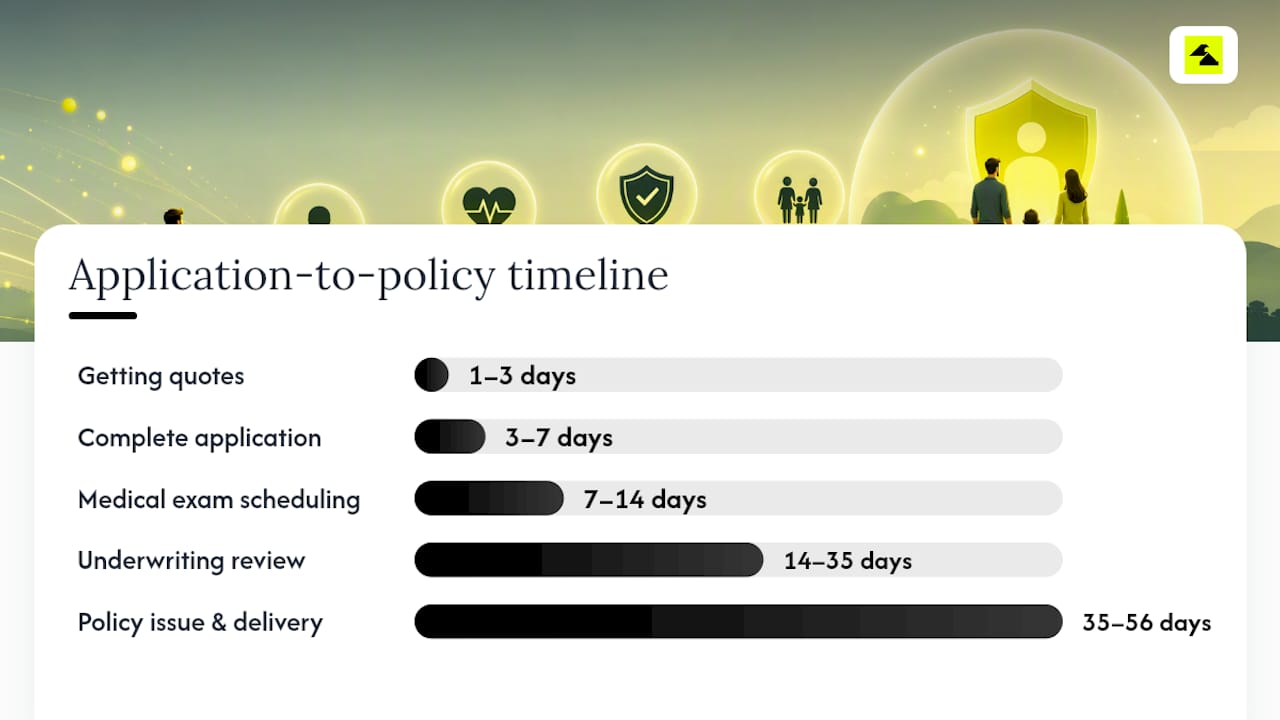
The process from first quote to active coverage typically takes 2–8 weeks for a fully underwritten policy. Here’s how it breaks down.
Getting quotes (Day 1–3): Online tools can return ballpark figures in minutes. Accurate quotes require your date of birth, coverage amount, term length, and basic health disclosures.
Completing the application (Day 3–7): Full application includes health history, medications, family history, and beneficiary designations. Accuracy here prevents contestability issues later.
Medical exam scheduling (Day 7–14): The carrier arranges and pays for the paramedical exam (blood draw, urine sample, blood pressure, height/weight). You don’t pay for this. Exams are typically done at your home or office.
Underwriting review (Day 14–35): The insurer reviews exam results, MIB records, prescription history, and sometimes requests an APS from your doctor. This is where most delays occur.
Policy issue and delivery (Day 35–56): Once approved, the policy is issued and delivered electronically or by mail. Coverage begins when you accept and pay the first premium.
No-exam (accelerated underwriting) policies can issue in 24–72 hours for healthy applicants under 50 with coverage amounts typically up to $1–3 million, depending on the carrier. The trade-off is that the algorithm may be more conservative than a human underwriter reviewing clean lab results.
Pro Tip: Before applying, pull together a list of all current medications (name, dose, prescribing condition), your primary care physician’s contact information, and dates of any hospitalizations or surgeries in the past 10 years. Having this ready cuts underwriting delays by days.
East Two West’s approach to finding competitive term life pricing
East Two West is an independent life insurance practice, not a captive agent for any single carrier. The practice accesses quotes from multiple carriers and is compensated by the issuing carrier after a policy is placed, not by charging clients directly.
Two paths are available depending on your situation. If you know what you want and prefer to move at your own pace, the online self-service quoting tool lets you compare real rates across carriers without a sales call. If your health history is more complex, a personalized consultation connects you with a licensed agent who can identify which carriers are most likely to offer favorable underwriting for your specific profile.
Either way, you’re comparing real carrier rates, not a single company’s pricing. That matters most when your health profile is anything other than textbook perfect.
Get your term life quotes from East Two West
Knowing the average term life insurance cost is useful context. Knowing your actual rate requires a real quote with your real information.
[

East Two West pulls quotes from multiple carriers simultaneously, so you see how different underwriting guidelines translate into actual monthly costs for your age, health, and coverage needs. No pressure, no single-carrier lock-in. Choose self-serve online or speak with a licensed agent for more complex situations.
To get an accurate quote quickly, have these ready: your date of birth, target coverage amount, desired term length, and a basic list of current medications or diagnosed conditions. Start your multi-carrier quote comparison now, or call to speak with a licensed agent if you’d prefer a guided walkthrough.
East Two West receives compensation from the issuing carrier when a policy is placed. There is no direct fee to the client for quotes or consultations.
Sources
Sample rate figures in this article are drawn from publicly published consolidated rate files and reflect typical level-term, 20-year policies at standard or noted health classes. Rates are illustrative; actual premiums depend on individual underwriting outcomes, state of residence, and carrier guidelines.
This article provides general information about life insurance costs and is not a substitute for personalized financial or insurance advice. Confirm current rates and policy terms with a licensed agent or your state’s insurance department.
Recommended
Comments